cybersecurity
AWS Adds Fine-Grained Access Control to Bedrock Tools: The Missing Layer for Multi-Agent Search
Multi-agent assistants are becoming good at searching company documents. The harder question is whether every agent should see the same results. AWS has now published a new approach for Amazon Bedrock Managed Knowledge Base…
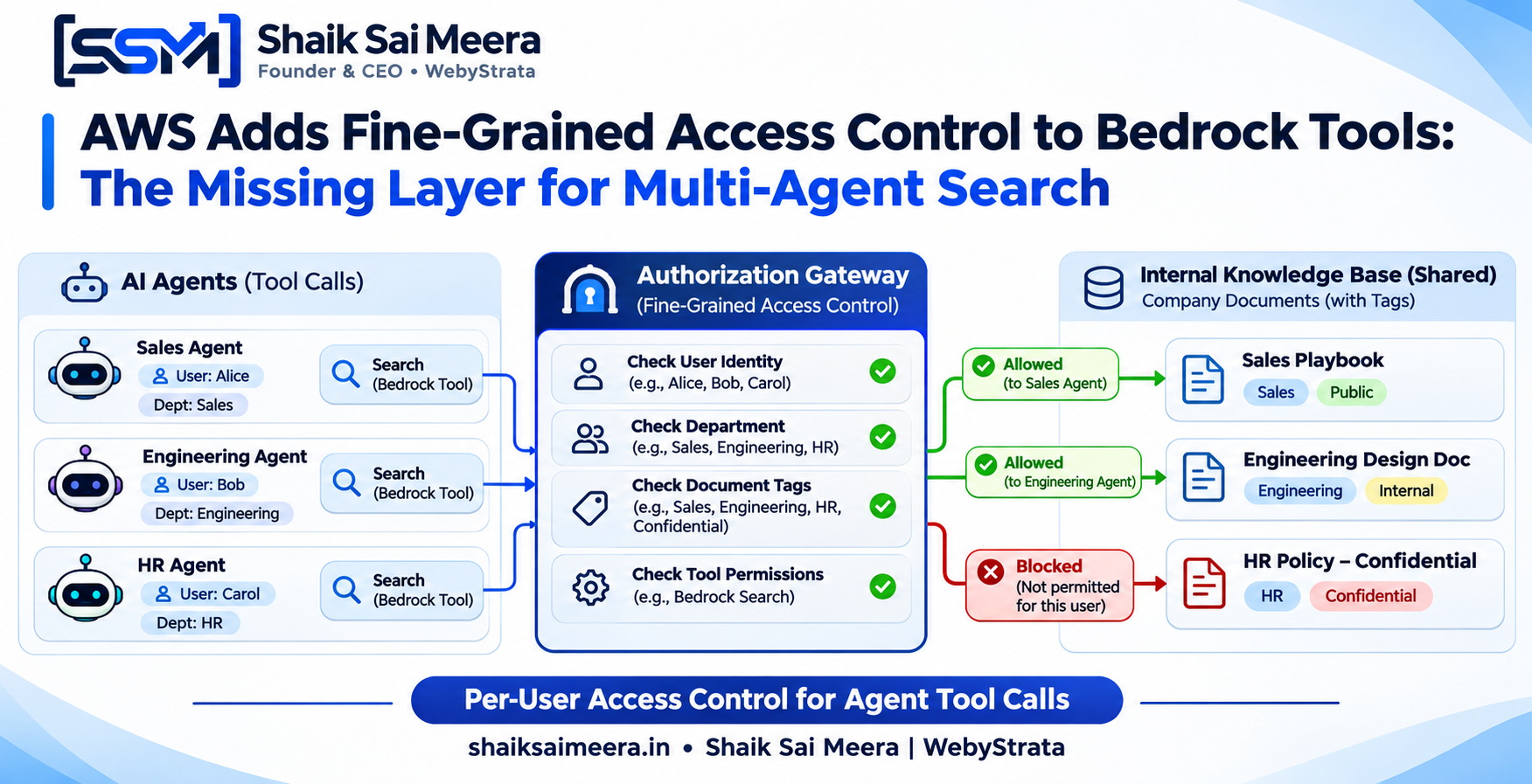
Multi-agent assistants are becoming good at searching company documents. The harder question is whether every agent should see the same results. AWS has now published a new approach for Amazon Bedrock Managed Knowledge Base tools that puts per-user and per-agent access checks in the search path, instead of assuming that a shared assistant can safely search a shared document store.
The timing matters. A single internal assistant might soon serve sales, engineering, finance, and human resources at once. Each department can use the same underlying knowledge base, but the user asking a question should not automatically inherit every document that the assistant can technically reach. AWS’s update is about making that distinction explicit at the tool boundary.
The problem with a shared search tool
In a simple retrieval-augmented generation setup, an agent receives a question, writes a search query, retrieves relevant chunks, and uses them to compose an answer. If the search tool has broad access, the assistant may be able to retrieve documents that the requesting user should never see.
The risk grows when an organization adds more agents. A sales agent, engineering agent, and HR agent may all call the same search function, even though they operate for different people and departments. A prompt such as “only use documents this person is allowed to read” is not the same as an enforceable access decision. It asks the model to follow a rule after retrieval, when the sensitive result may already be in its context.
A safer design checks permission before the document is returned. That is the central idea behind the AWS announcement.
What AWS is adding
AWS describes a pattern in which a Bedrock agent’s knowledge-base tool call carries the context needed to evaluate access. The control path can consider the requesting user, the department or group they belong to, document metadata such as tags, and the permissions associated with the tool itself.
That creates a decision point between the agent and the shared knowledge base:
- Identity: who is asking the question?
- Context: which team, role, tenant, or business unit does that person belong to?
- Document scope: which metadata tags or collections are permitted for that context?
- Tool scope: is this particular agent allowed to call the search tool at all?
Only after those checks pass should the retrieval operation return matching information. The result is not merely a better prompt. It is a narrower search boundary.
A practical example: one assistant, three departments
Imagine a company with a shared knowledge base containing a sales playbook, engineering design documents, and confidential HR policies. The organization wants one conversational assistant rather than three separate products.
A sales employee asks for the latest enterprise pricing guidance. The sales agent calls the search tool with the employee’s identity and department. The authorization layer permits documents tagged for sales and public company information, then excludes engineering and HR collections before retrieval.
An engineer asks a question about a system component. The same underlying tool can search engineering documents, but it does not automatically expose HR policy files. If an HR employee asks about leave rules, the HR agent receives the relevant confidential policy while other departments receive a blocked or empty result for that collection.
The important detail is where the filtering happens. The protected document should be excluded before it becomes retrieved context, not merely removed from the final answer after the model has seen it.
Why this is different from a simple prompt rule
Prompts are useful for explaining goals and response style. They are a weak place to enforce a boundary that must survive model variation, prompt injection, ambiguous wording, and multi-step agent behaviour. An agent may generate several searches while working on one request, so each tool call needs the same permission context.
Fine-grained access control moves the decision into an enforcement layer that can evaluate structured attributes. The model can still decide what to search for, but the tool can reject a request or restrict the result set when the user, agent, document tag, or permitted operation does not match.
The operational trade-offs
This design improves separation, but it does not make access control automatic. Teams still have to maintain reliable identity data, consistent document tags, and clear ownership of collections. If a file is tagged incorrectly, a technically correct policy can still produce the wrong result. If permissions are too broad, a clean enforcement mechanism simply enforces an overly broad policy.
There is also a performance trade-off. Every retrieval request may need additional identity and policy evaluation, especially when an agent fans out into multiple searches. Builders should measure the added latency and decide which checks are required for each collection. A public product FAQ may need a simpler path than a confidential employee record.
Auditing matters as well. A useful record should show which user initiated the request, which agent and tool were called, which policy decision was made, and which documents were eligible for retrieval. That makes it easier to investigate an unexpected answer without treating the model’s final text as the only evidence.
What builders should take from the update
The broader lesson is that agent permissions should travel with the tool call. A search function should receive a trustworthy identity and authorization context, enforce the policy before retrieval, and return only the data that the caller is entitled to use.
Teams designing similar systems can ask a few practical questions:
- Does the search service know which user initiated the request?
- Are agent permissions narrower than the permissions of the whole organization?
- Are documents classified with metadata that policy rules can evaluate?
- What happens when identity, department, or document classification is missing?
- Can the system show why a result was allowed or blocked?
These questions apply beyond Bedrock. Any system that lets an agent call internal search, ticketing, CRM, storage, or database tools needs a clear boundary between what the model wants to retrieve and what the user is allowed to receive.
The missing layer is not another model
A shared knowledge base can make an organization’s information easier to use, but it can also make the cost of a permission mistake larger. AWS’s update highlights a practical direction: let agents coordinate work, while a separate policy layer decides which data each tool call may touch.
That separation will not solve every identity or governance problem. It does make the architecture easier to reason about. The agent can be flexible; the access decision can remain explicit, repeatable, and testable. For multi-agent systems, that may be the difference between a convenient search experience and one that organizations can operate with confidence.
This article is a general information summary based on the cited public sources. It is not legal, cybersecurity, or compliance advice.
Related Articles


