hosting
Cloud Storage Advisor Adds CMEK Compliance Findings
Google Cloud’s Storage Intelligence advisor can now surface Cloud Storage objects that violate default CMEK policies or enforced encryption rules and guide re-encryption work.
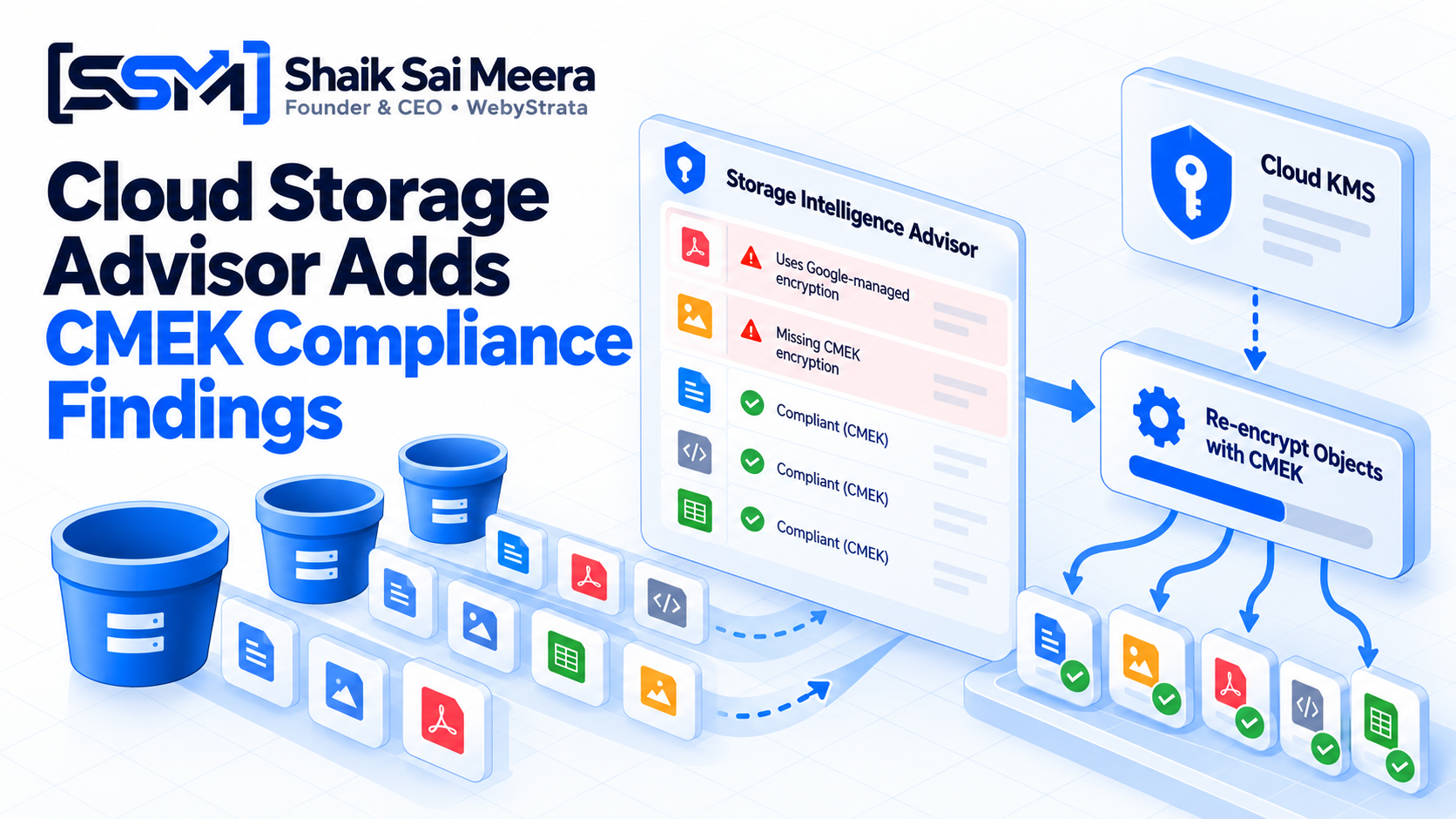
Setting a customer-managed encryption key on a Cloud Storage bucket does not automatically change every object already inside it. Older objects may still use Google-managed encryption or customer-supplied keys, even after a team tightens the bucket’s encryption policy. That gap is easy to miss when oversight happens at the bucket level.
Google Cloud has added preview security and compliance findings to Storage Intelligence advisor. The October 30, 2026 Cloud Storage release notes say the advisor can identify buckets whose objects violate default customer-managed encryption key (CMEK) policies or enforced encryption rules, and can point teams toward re-encrypting the affected objects. Google’s advisor documentation explains how the findings fit into organization-, folder-, and project-level storage oversight.
What changed
Storage Intelligence advisor already provides metrics, anomalies, and recommendations across Cloud Storage environments. The new security and compliance findings add an object-encryption perspective. Instead of checking only whether a bucket has a default key configured, teams can discover when the objects inside the bucket do not match that policy.
Google documents two new finding types:
- Objects violate default CMEK bucket policies. A bucket has a default Cloud KMS key, but one or more objects are not encrypted with CMEK.
- Objects violate enforced encryption rules. A bucket’s encryption enforcement configuration restricts certain methods, but objects still use a disallowed method.
The distinction matters because a bucket policy and an object’s existing encryption metadata are not the same thing. New uploads may follow the current rule while older data remains unchanged.
The before-and-after for a storage team
Before this update, a team that introduced a default CMEK policy had to build its own inventory process to locate objects that predated the policy or were uploaded with an explicit encryption choice. The team might query metadata, export results, and coordinate rewrites without a single place that connected the finding to the affected bucket.
After enabling Storage Intelligence, the advisor can aggregate object-level encryption violations at the bucket level and present them as security findings. Google says the advisor can operate across projects, folders, or organizations, so a platform team can begin with an environment-wide view and drill into the bucket that needs work.
That is especially useful after a policy change. A bucket may look compliant from its configuration while a historical object set still needs remediation. The new finding turns that hidden difference into a reviewable work item.
How the remediation path works
The advisor does not silently rewrite objects. It identifies the gap, and the team chooses how to respond. Google’s documentation describes a workflow that starts with the finding details, identifies the affected bucket and default Cloud KMS key, queries object metadata when necessary, and then rewrites the objects with the allowed encryption method.
For live objects using standard Google-managed encryption, teams can use Storage Insights datasets to create a manifest and Storage batch operations to rewrite the objects with the bucket’s default CMEK. For objects encrypted with customer-supplied keys, Google documents a separate Cloud CLI path because Cloud Storage does not retain the customer-supplied key needed for batch decryption.
The important operational boundary is that re-encryption is a data rewrite. It needs permissions, a controlled change window, storage and operation planning, and a way to confirm that the rewritten objects remain available to the applications that use them.
A practical review workflow
- Start with scope. Review findings at the organization, folder, and project levels, then choose one bucket with a clear owner and a manageable object set.
- Confirm the intended policy. Verify the bucket’s default KMS key, enforcement rules, and the object types that the application expects to read.
- Separate live and retained data. Object Versioning and soft delete can preserve older non-compliant versions after a rewrite or delete operation.
- Identify the objects. Use Storage Insights datasets to list affected objects, their encryption type, and their current state before preparing a rewrite.
- Choose the rewrite method. Use batch operations for eligible GMEK objects and the documented CLI process for CSEK objects.
- Use a dry run where available. Validate manifests, permissions, key references, and affected object counts before making changes.
- Verify the next refresh. Google says findings refresh every 24 hours, so the dashboard may not clear immediately after remediation.
What the feature does not guarantee
The new findings improve visibility; they do not make an encryption program complete by themselves. A finding says that an object’s encryption metadata does not match a bucket policy or enforcement rule. It does not establish whether the selected key has the right lifecycle, access model, rotation plan, or separation of duties for a particular workload.
The capability is also in Preview. Google’s documentation says baseline findings can appear within 48 hours after Storage Intelligence is enabled and refresh every 24 hours. That means teams should not treat an empty dashboard immediately after activation as proof that every object has been evaluated.
Remediation can also interact with data lifecycle settings. Google notes that rewriting a live object can leave a non-compliant noncurrent version when Object Versioning is enabled, and soft delete can retain an older version until its retention period expires. A finding may therefore remain active even after the current live object has been re-encrypted.
Why this matters for cloud operations
Encryption policies often become stricter over time. A team may introduce CMEK for a new workload, later expand the policy to an existing bucket, and then discover that historical data was created under different assumptions. The difficult part is not writing the new rule; it is finding and safely updating the objects that existed before it.
Storage Intelligence advisor’s new findings create a more direct bridge between policy and object state. Platform teams can use the advisor to find the buckets that deserve attention, then use the documented metadata and rewrite workflows to plan the actual remediation.
The best rollout is controlled: enable the preview on a small set of projects, validate the findings against known buckets, document the rewrite path, and involve application owners before changing large object collections. The feature does not remove the need for careful key and data management, but it can replace a blind spot with an actionable inventory.
This article is a general information summary based on the cited public sources. It is not legal, cybersecurity, or compliance advice.
Related Articles