Tech Insights
Databricks Gives Its AI Assistants a Searchable Knowledge Layer
Databricks has made Genie Search and Genie Ontology generally available, connecting enterprise knowledge sources with permission-aware search and a business-aware context layer for its AI assistants.
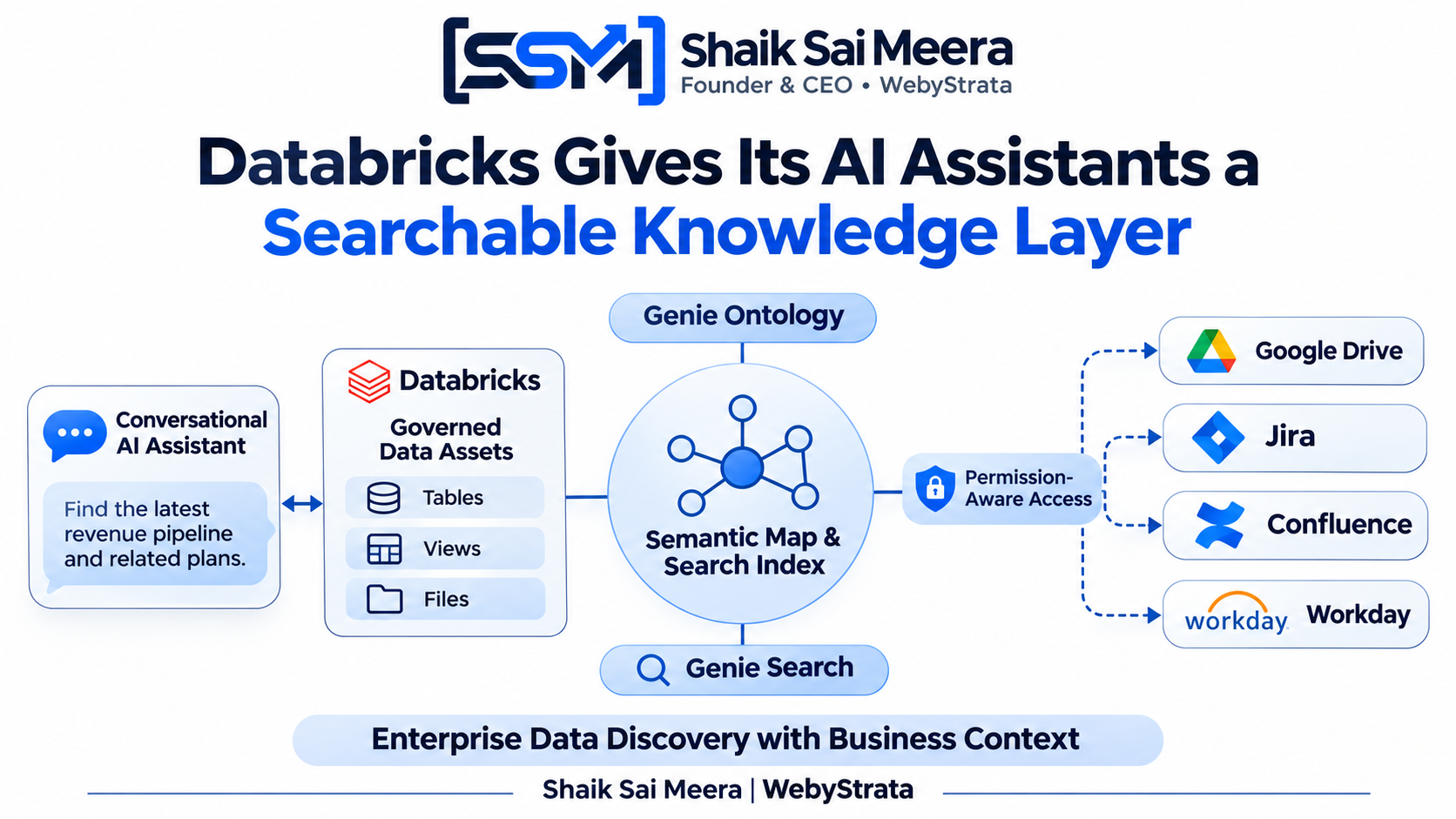
Enterprise AI assistants rarely fail because a document does not exist. They fail because the document, table, dashboard or policy lives in a different system, uses different language and carries different access rules. Databricks’ latest Genie updates address that coordination problem by putting search and business context closer to the assistant itself.
In its November 9, 2026 product update, Databricks announced general availability for Genie Search and Genie Ontology. The official Databricks release notes say Genie Search can index organizational knowledge from sources including Google Drive, Jira, Confluence and Workday while preserving each document’s permissions. Genie Ontology adds a business-aware map for Genie One, Genie Code and other AI agents.
The important change is not simply that an assistant can search more places. It is that retrieval and meaning are being treated as part of the same governed data layer.
Before: the assistant knew the question, not the organization
Imagine an analyst asking, “Why did the regional pipeline fall last quarter, and which plan changed?” The answer may be spread across a sales table, a finance dashboard, a planning document and a project ticket. A general chatbot can summarize the text it receives, but it cannot reliably discover every relevant source or understand that “pipeline,” “bookings” and “qualified opportunity” mean different things in different teams.
That gap creates a familiar workflow. The user searches several systems, opens documents manually, copies context into a prompt and then asks the assistant to compare the material. The assistant may be helpful after that preparation, but the human has done the information architecture work first.
After: search and semantics become part of the assistant
Genie Search is designed to make organizational knowledge discoverable inside Genie One. Databricks says the service indexes content from connected systems and keeps document permissions with the indexed content, so users should see only material they could already access in the original source.
That permission-aware design matters because enterprise search is not just a relevance problem. It is also an authorization problem. A search result that is accurate but visible to the wrong person is not a successful enterprise feature. By carrying permissions into the search layer, Databricks is describing a boundary between “the organization has this information” and “this user may retrieve it.”
Genie Ontology addresses a different limitation. It combines modeled knowledge defined through Unity Catalog semantics with learned knowledge that Genie extracts from assets and usage. In practical terms, the ontology is meant to give an assistant a map of how the organization names, relates and interprets its data.
A concrete example: from lookup to explanation
Suppose a company has a table called oppty_stage_history, a finance report that calls the same concept “late-stage pipeline,” and a Workday directory that identifies regional sales leaders. A simple search tool may find each item independently. A semantic layer can help the assistant connect the objects: opportunities belong to accounts, accounts belong to regions, and the reported metric has a defined time window.
The user’s question can then become a cross-source workflow: locate the relevant data, retrieve the supporting documents, respect the user’s existing permissions and explain which business definitions were used. The assistant is still not a substitute for a data owner or an analyst. The value is that the first pass can begin with organizational context instead of a blank prompt.
Why the two features work better together
Search without semantics can produce a large pile of relevant-looking results. Semantics without broad search can explain the data that has already been modeled while missing the document where a decision was recorded. Genie Search and Genie Ontology address those two sides of the problem.
Genie Search helps the assistant find knowledge across connected systems. Genie Ontology helps it interpret relationships and business meaning inside the Databricks environment. Databricks says the ontology powers Genie One, Genie Code and other AI agents, which suggests a common context layer rather than a separate knowledge setup for every assistant experience.
That shared layer could be useful for organizations that want multiple AI surfaces to use consistent definitions. A data assistant, coding assistant and workflow agent may still have different tools, but they benefit when “customer,” “active contract” or “net revenue” do not change meaning from one interface to another.
The trade-offs are in the connections and the definitions
General availability does not remove the work of building a useful knowledge layer. Connected sources still need to be selected, indexed and maintained. Permissions can be preserved only if the source identities and access rules are mapped correctly. A search index can locate a document, but it cannot repair an outdated policy or an ambiguous metric definition.
The ontology also depends on the quality of the organization’s modeled knowledge. Learned relationships can help, but teams still need clear ownership for important business terms. Without that ownership, an assistant may retrieve more information while leaving the underlying disagreement unresolved.
Databricks also notes that releases are staged, so availability may vary by account. That makes rollout timing part of the product story. A feature can be generally available in the release notes while individual workspaces receive it later.
What this changes for platform teams
For platform teams, the useful shift is from “Which chatbot should we connect?” to “Which knowledge and permission layer should every assistant use?” That question encourages a more durable architecture. Search connectors, identity mapping, semantic definitions and audit expectations become shared platform concerns instead of one-off prompt engineering tasks.
For data teams, the update raises the importance of business metadata. Tables and dashboards are more valuable to an assistant when their meaning, ownership and allowed use are explicit. For end users, the benefit is simpler: fewer tabs, less copying and a better chance that an answer begins with the organization’s own language.
Databricks’ Genie update is a meaningful step toward enterprise AI that can navigate the systems around a business, not just the text placed in front of it. The memorable part is not the promise of a smarter chatbot. It is the decision to make search, permissions and business meaning part of the same operating surface.
Editorial note: This article is a general information summary based on the cited public sources. It is not legal, cybersecurity, or compliance advice.
Related Articles


