Tech Insights
GitHub Expands OIDC-Based S3 Audit Log Streaming to GHE.com: What Changes for Cloud Governance
GitHub has expanded OIDC-based Amazon S3 audit-log streaming to GitHub Enterprise Cloud with data residency, known as GHE.com. The change was published in GitHub’s Changelog on November 19, 2026, and it is meaningful because…
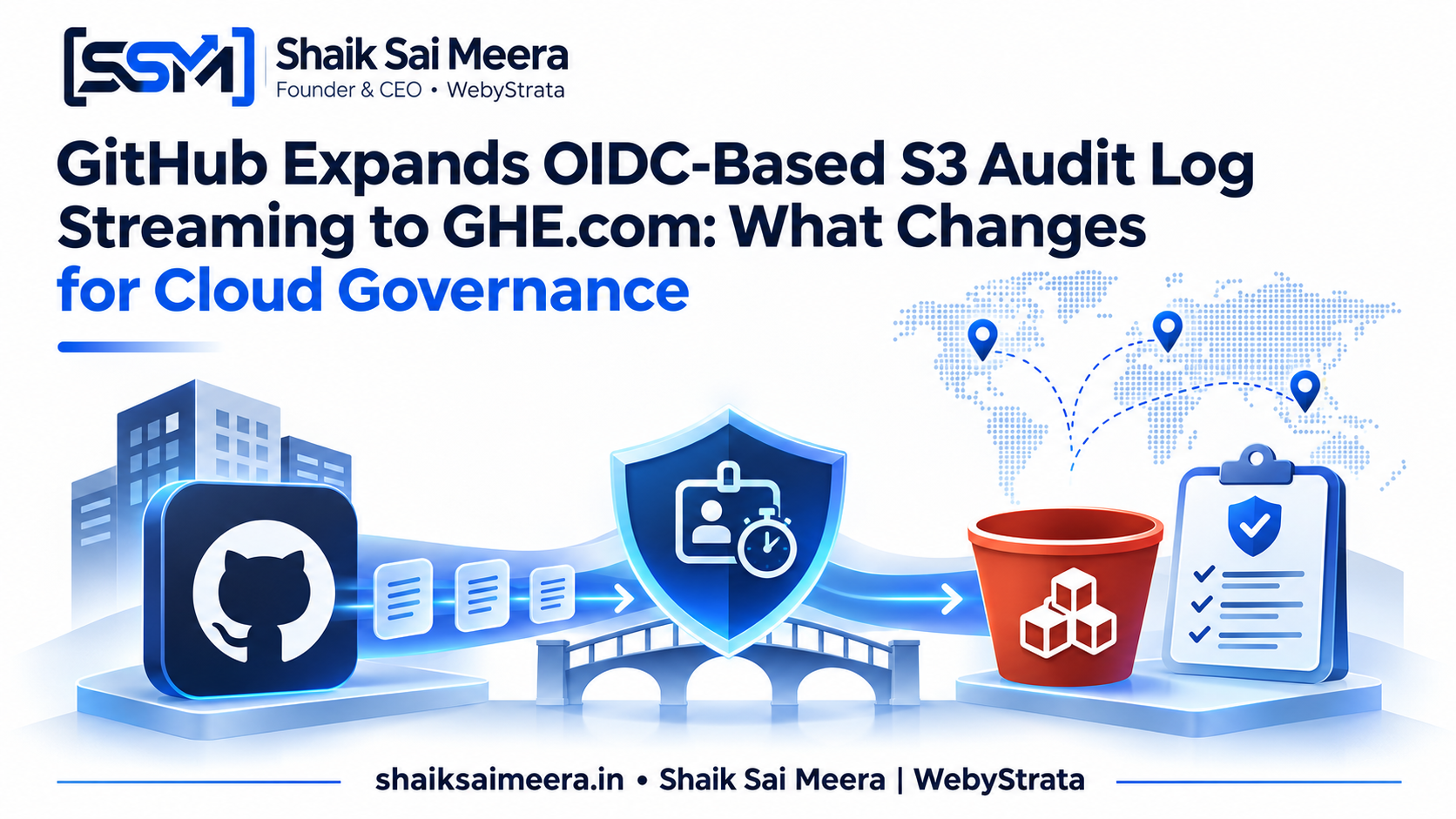
GitHub has expanded OIDC-based Amazon S3 audit-log streaming to GitHub Enterprise Cloud with data residency, known as GHE.com. The change was published in GitHub’s Changelog on November 19, 2026, and it is meaningful because it extends a credentialless audit pipeline into an enterprise hosting model where data residency is part of the operating picture.
This article was prepared on November 19, 2026, in India Standard Time, using the official GitHub Changelog announcement and GitHub’s setup documentation. The focus is practical: what the expansion changes, how to think about the trust relationship, and which operational checks help an audit stream remain useful after it is enabled.
The change in plain language
GitHub says enterprise audit logs can now be streamed to Amazon S3 using OpenID Connect on GitHub Enterprise Cloud with data residency. The capability already existed for github.com, and this update extends it to GHE.com. GitHub describes the benefit directly: organizations can authenticate the connection without storing long-lived AWS credentials on GitHub.
That is more than a new destination toggle. It changes the shape of the connection between GitHub and AWS. Instead of placing a permanent access key in a secret store and asking a workflow or service to reuse it, the integration can rely on a short-lived identity token and an AWS trust policy. The S3 bucket still needs a carefully bounded permissions model, but the credential lifecycle is different.
Why data residency changes the design conversation
For an organization using GitHub Enterprise Cloud with data residency, the location and processing path of audit data can be part of the platform design. Audit events may be used for investigation, change tracking, access reviews, and internal reporting. Moving those records into an S3 bucket therefore creates an operational relationship between the GitHub deployment model, the AWS account, the bucket region, retention settings, and the teams allowed to read the records.
The new GHE.com support does not eliminate those design choices. It makes the credentialless pattern available in that hosting context. A useful implementation plan should document which enterprise is the source, which AWS account owns the bucket, which region receives the stream, how long objects are retained, and which downstream tools read them. The documentation is the control surface; the stream is only the transport.
What OIDC changes compared with stored keys
A long-lived AWS access key has to be created, stored, rotated, monitored, and removed. It may be copied into an integration secret, a deployment system, or a troubleshooting session. OIDC replaces that reusable credential with a signed identity assertion that AWS can validate against a configured trust relationship. The resulting role session is temporary and can be scoped to the task that needs it.
The trade-off is that the trust policy becomes more important. AWS must know which GitHub issuer is trusted, which repository or enterprise identity is allowed, what audience is expected, and which role can be assumed. A broad trust rule can be just as problematic as a broad access key. The safer mental model is not “OIDC is automatically secure”; it is “OIDC moves the security work from secret storage to identity conditions and role policy.”
A concrete workflow for the first rollout
Imagine a company with a GHE.com enterprise that wants a durable audit trail in an AWS account used by its platform team. The team can approach the rollout in five small stages.
First, define the destination. Choose the AWS account and S3 region, create a bucket dedicated to audit records, and decide whether the bucket should be isolated from application data. A dedicated destination makes ownership and retention easier to explain.
Second, define the identity boundary. Establish the OIDC trust relationship and restrict the role to the GitHub enterprise context that should publish audit logs. Avoid using a generic organization-wide role when a narrower subject or audience condition is available. Record the exact conditions in the platform repository or infrastructure documentation.
Third, define the write boundary. The publishing role needs only the S3 actions required to deliver audit objects to the chosen prefix or bucket. It does not need broad read, delete, or bucket-administration permissions merely because the destination is S3.
Fourth, test with a known event. Trigger or wait for a normal enterprise audit event, then confirm that an object arrives, has the expected prefix and format, and can be read by the intended audit consumer. Check the AWS logs for the assumed role session and verify that the session maps back to the expected GitHub identity.
Fifth, operate it like a production pipeline. Monitor delivery failures, unexpected object volume, role-assumption errors, bucket policy changes, and retention lifecycle transitions. A stream that works on day one but fails silently after a region, enterprise, or policy change is not a dependable audit record.
What teams should verify before calling it complete
There are three useful verification questions. Can the source be identified? The audit team should know which GHE.com enterprise produced an event and whether the object path preserves that context. Can the destination be protected? The bucket policy, encryption settings, retention controls, and access logs should match the organization’s storage model. Can the record be used? A security or compliance workflow should be able to search, export, and correlate the events without depending on one engineer’s personal credentials.
Also test failure behavior. Temporarily deny the expected write permission in a non-production test path and observe how the integration reports the failure. Check whether operators receive a clear signal, how much data can be delayed, and which recovery step restores delivery. The failure test often reveals more about operational maturity than the successful first upload.
Limits and trade-offs
OIDC reduces the burden of long-lived AWS credentials, but it does not decide retention, legal hold, access review, or incident response for the organization. S3 storage still needs lifecycle planning, monitoring, and cost awareness. Data residency support also does not mean every downstream copy automatically follows the same location policy; exports, indexes, analytics systems, and backups need their own review.
The expansion is most useful when it is treated as a platform pattern: GitHub supplies identity context, AWS supplies a controlled storage destination, and the organization documents the trust, permissions, retention, and verification around both. That division makes the feature easier to audit and easier to repair when the environment changes.
GitHub’s GHE.com expansion is a small Changelog entry with a large operational lesson. The value is not merely that audit logs can reach S3. The value is that an enterprise can move the stream without making a permanent AWS secret part of the integration’s daily life—and can make the resulting trust relationship visible enough to review.
This article is a general information summary based on the cited public sources. It is not legal, cybersecurity, or compliance advice.
Related Articles