Tech Insights
Python Packaging 26.4 Drops Python 3.9: What Build Pipelines Should Check Now
As of 24 November 2026 (IST), the Python Packaging Authority’s packaging 26.4 release is the latest compatibility checkpoint for teams that build, resolve, and publish Python software. The release removes support for Python 3.9…
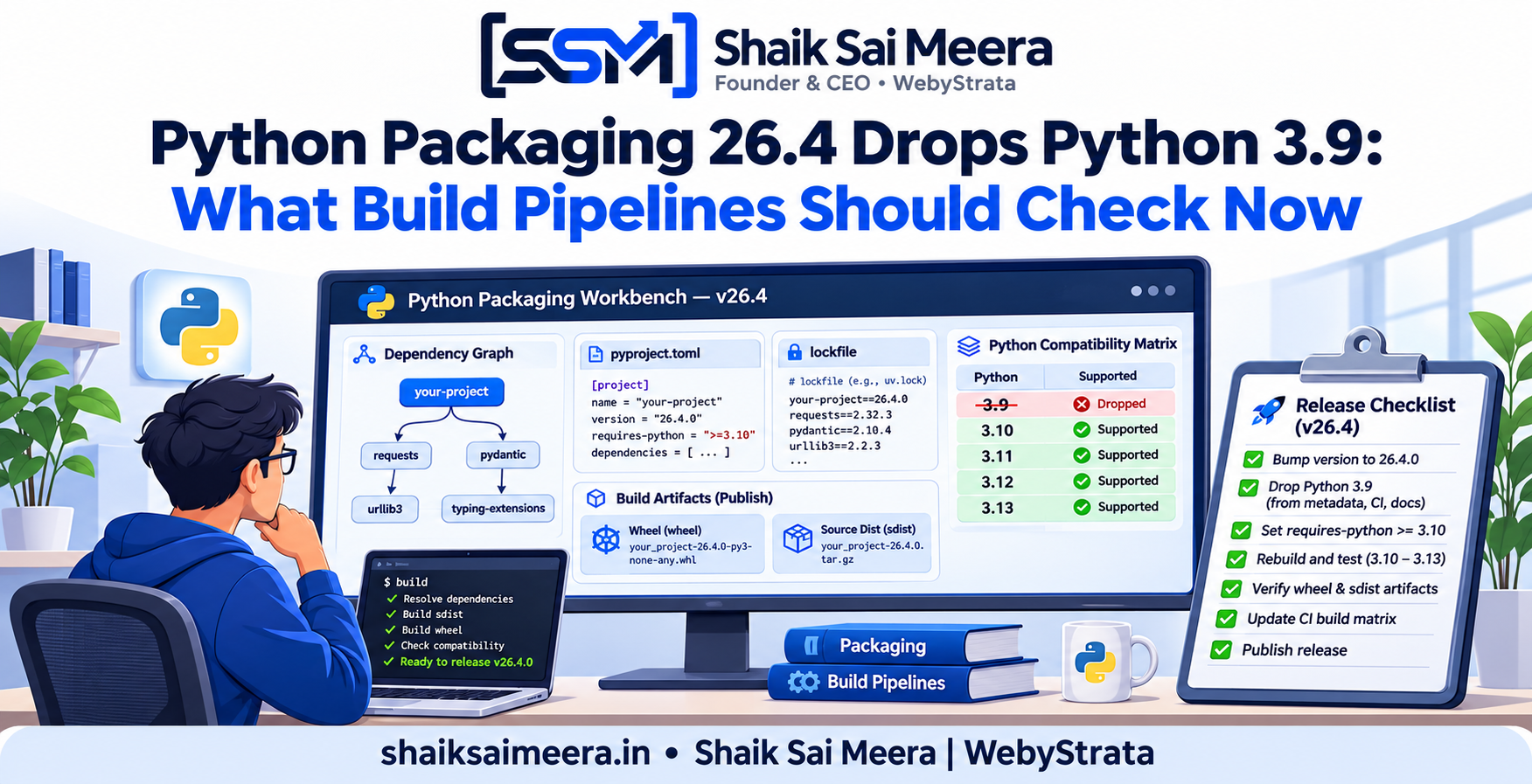
As of 24 November 2026 (IST), the Python Packaging Authority’s packaging 26.4 release is the latest compatibility checkpoint for teams that build, resolve, and publish Python software. The release removes support for Python 3.9 and adds new APIs for environment markers, version ranges, interpreter ABI tags, and richer parse errors. Those changes are useful, but they can surface in a pipeline before they appear in application code: a resolver, build backend, lockfile tool, or internal package may now behave differently.
The release announcement on Python.org’s Packaging discussion lists the changes, while the packaging 26.4 project page on PyPI provides the published artifacts and provenance. For build and platform teams, the question is not simply whether to install the newest version. It is whether the organization’s supported Python matrix, lockfiles, publishing jobs, and developer environments agree with the new floor.
The immediate change: Python 3.9 is no longer supported
Packaging 26.4 drops support for Python 3.9. That does not automatically stop every Python 3.9 application from running, and it does not mean a package resolver will upgrade every environment immediately. It does mean that a pipeline which lets packaging 26.4 enter a Python 3.9 environment may fail during installation or produce an unsupported combination that is difficult to diagnose later.
Start by finding where packaging is present indirectly. It may be installed by pip, a build frontend, a backend, a linter, a test utility, or an internal base image. Look at lockfiles and constraints, not only the top-level requirements file. Then compare that inventory with the runtimes your organization actually supports, including developer laptops, CI runners, release builders, serverless jobs, and long-lived customer images.
Turn the release into a matrix test
A practical test is a small compatibility matrix rather than a blanket upgrade. For a service that supports Python 3.10 through 3.15, create jobs for each supported version and run the same sequence:
- Resolve from a clean environment. Do not reuse a warm virtual environment. Test the normal install path, the locked install path, and the path used by your build system.
- Build both artifacts. Produce a source distribution and a wheel. Check that metadata, entry points, package data, and generated files are unchanged where they should be.
- Install the artifacts, not the checkout. A green test run against local source can miss a missing file or incorrect build configuration.
- Run the application and test suite. Include import checks, plugin discovery, command-line entry points, optional extras, and any environment markers used for platform-specific dependencies.
- Publish to a staging index. Verify that provenance, signatures or attestations, metadata, and promotion rules still behave as expected before touching the production repository.
If Python 3.9 remains a supported customer runtime, pin a compatible packaging range for that environment and plan a separate migration. Do not quietly delete the old job just to make the new release green; that turns a visible compatibility decision into an invisible support change.
What the new APIs mean for tooling authors
Packaging 26.4 is more than a version-floor release. The project adds prepare_environment() and Marker.evaluate_prepared() so callers can reuse one prepared environment across repeated marker evaluations. That matters to resolvers and build tools that evaluate many dependency conditions. Reusing prepared state can reduce repeated setup work, but callers should test that cached context is not accidentally reused across different target environments.
There is also a public interpreter_abi() helper for obtaining the ABI tag of the running interpreter. Tool authors can use it to make wheel selection or diagnostics more explicit, but they should test unusual interpreters, platform tags, PyPy, free-threaded builds, and cross-compilation flows rather than assuming a single CPython layout.
Version-range support expands the ways a tool can represent and compare accepted versions. Richer InvalidRequirement and InvalidMarker details expose a message, source, and span for syntax errors. That is a chance to improve user-facing diagnostics: show the exact failing text and location instead of returning a generic “invalid requirement” message.
A realistic CI example
Suppose a company publishes a CLI used by customers on Python 3.10, while its development team is moving to Python 3.15. Its previous pipeline tested application behavior but not the release toolchain as a product. After the packaging upgrade, the team adds a job that builds its lockfile, creates a wheel and source distribution, installs each artifact in isolated 3.10, 3.11, 3.12, 3.13, and 3.15 environments, and runs the CLI’s help, plugin, and upgrade commands.
The job also checks the package metadata’s Requires-Python value, because an application that still supports 3.10 should not accidentally publish a declaration that excludes it. The release is promoted only after the staging index accepts the artifacts and a clean installation works from the same constraints used by customers.
Trade-offs and migration choices
Upgrading early gives teams better diagnostics and exposes stale Python 3.9 assumptions before a security or feature release forces the issue. It can also improve performance in repeated version and marker operations, according to the release announcement.
The cost is coordination. Some internal tools may still run on 3.9, and a shared build image can hide which component pulled in packaging 26.4. Pinning forever avoids immediate breakage but creates a future upgrade cliff. A better compromise is explicit separation: keep a short-lived compatibility constraint for legacy jobs, move supported build images to a current version, and set a date for removing the old runtime lane.
Takeaways
Packaging 26.4 should be treated as a build-pipeline change, not only a library bump. Inventory indirect dependencies, test every supported Python version from clean environments, build and install real artifacts, and verify metadata before publishing. Tool authors should exercise the new marker, ABI, version-range, and parse-error APIs across unusual platforms. Most importantly, keep Python 3.9 support visible: either migrate it deliberately or constrain the toolchain explicitly while the organization finishes the transition.
This article is a general information summary based on the cited public sources. It is not legal, cybersecurity, or compliance advice.
Related Articles