Tech Insights
Amazon Connect Conversational Analytics Adds Five-Language Call Analysis: What Contact Centers Should Change
Amazon Connect has added a practical capability for multilingual contact centers: conversational analytics can now analyze a voice contact in up to five languages. The change is easy to underestimate because it appears as…
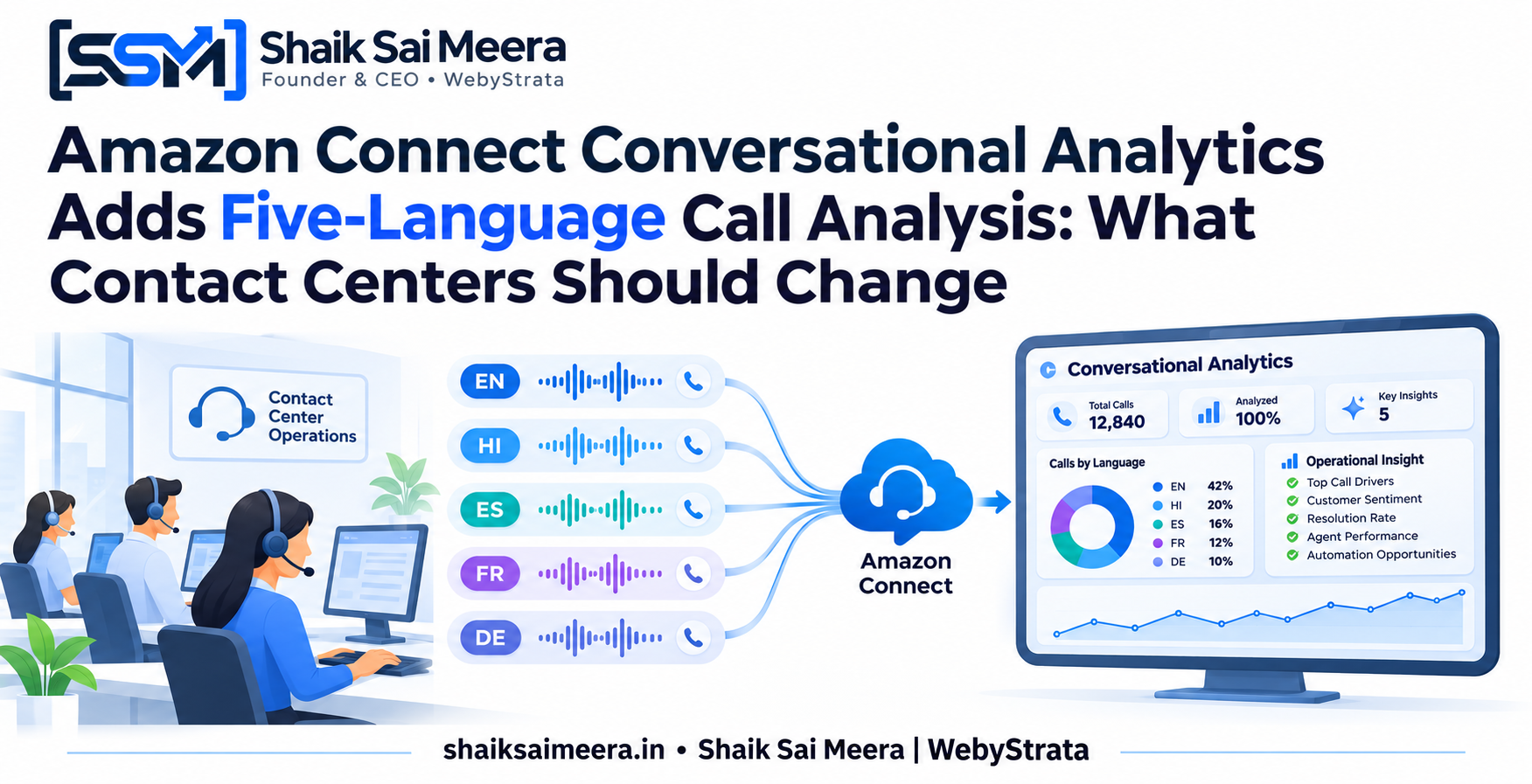
Amazon Connect has added a practical capability for multilingual contact centers: conversational analytics can now analyze a voice contact in up to five languages. The change is easy to underestimate because it appears as a configuration option in a flow, not as a new standalone product. Its operational effect is larger. A support organization can keep one conversation in scope for transcription, summaries, sentiment, redaction, and other analytics even when the customer and agent move across languages.
For teams operating in India, Southeast Asia, Europe, or any market where customers naturally switch languages, this shifts the question from “Can we record the call?” to “Can our quality and service systems understand the call consistently?” AWS documented the update on November 22, 2026 (India Standard Time reference: November 23, 2026, early morning), and the feature is now described in the Amazon Connect Customer administrator guide.
What changed
In the Set recording, analytics, and processing behavior block, administrators can select up to five analytics languages for a voice contact. The first language is the preferred language. AWS also supports choosing the list dynamically at runtime, using a Lambda result or a data-table value, so a flow can select languages from customer, queue, or interaction metadata instead of publishing a separate flow for every language combination.
The important detail is that this is not a promise that every analytics feature works identically in every language. AWS warns when a selected language does not support a chosen capability. For example, the official procedure shows that Finnish can be selected for analytics while redaction and sentiment analysis are unavailable for that language. The call can still be analyzed, but unsupported features do not apply to the relevant segments. Teams should treat the feature as a language-aware pipeline, not a universal “all AI features in all languages” switch. See the Amazon Connect multilingual analytics procedure for the configuration steps and runtime rules.
Why this matters to operations
Many contact centers already record calls, but their management systems are often language-blind. A Hindi-speaking customer may receive a good conversation while the quality system produces an incomplete transcript. A multilingual queue may be measured by handle time while losing the reasons for repeat calls, escalation, or dissatisfaction. Managers then make staffing and training decisions from a partial sample.
Five-language analysis can improve coverage in three ways. First, it can bring more calls into post-contact review, helping quality teams compare outcomes across language queues. Second, it creates a more consistent path to summaries and information extraction where those features are supported. Third, it exposes the boundary between supported transcription and supported safeguards, which is useful for compliance and risk planning.
The feature also supports a common real-world pattern: code-switching. A customer may begin in English, explain a local address or product issue in another language, and return to English for payment or confirmation. A static single-language setting is a poor fit for that interaction. A list of likely languages gives the analytics pipeline more context, although it does not remove the need to test language detection, dialect handling, and transcript quality.
A practical example
Consider an online retailer serving customers across India. Its voice queue receives English, Hindi, Bengali, Tamil, and Telugu calls. Previously, the team may have created separate flows or selected only the most common language, then accepted weaker analytics for the rest.
With the new configuration, the team can publish a voice flow with five language codes in priority order. For a general queue, that may be en-IN, hi-IN, bn-IN, ta-IN, and te-IN, subject to the languages and capabilities available in the instance. For a specialized queue, a Lambda function could return a smaller list based on the customer profile or the language selected in the IVR.
The team should then run a controlled pilot. Select a representative sample from each queue, compare transcripts with human review, measure summary accuracy, and verify that sensitive-data redaction behaves as expected. A simple dashboard can track calls by selected language, transcript completeness, transfer rate, repeat contact rate, and supervisor corrections. The aim is not to prove that AI is perfect; it is to show where the analytics are reliable enough to support a decision.
Trade-offs teams should plan for
The first trade-off is feature unevenness. AWS’s supported-language matrix shows that capabilities such as sentiment analysis, redaction, real-time analytics, and summaries do not necessarily have the same coverage. A language can be analyzable while still lacking a safeguard or downstream enrichment. Teams should document the exact feature set per language before making compliance or performance claims. The Amazon Connect supported-language matrix should be treated as the source of truth for that review.
The second trade-off is complexity in flow design. Dynamic language lists are powerful, but they introduce validation work. The runtime list must contain one to five unique, valid language codes, and a language cannot be repeated with multiple dialects in the same list. A malformed or unsupported list can send the flow down its Error branch. That means language selection needs monitoring, test cases, and an operational fallback.
The third trade-off is governance. More complete analytics can mean more transcripts, summaries, and extracted information entering operational systems. Contact centers should review retention, access control, redaction, human review, and regional data-handling requirements before expanding coverage. Better observability is valuable only when the organization can protect the data it observes.
What contact centers should do next
Start with a language-capability map, not a broad rollout. List the languages in your top queues and map each one to transcription, real-time analytics, post-call analytics, sentiment, summaries, redaction, and information extraction. Mark gaps clearly. Then choose one high-volume queue for a two-week pilot and compare AI outputs with supervisor-reviewed samples.
Next, decide where language selection should happen. A static list may be simplest for a predictable queue. Runtime selection is better when customer profiles, IVR choices, or routing metadata provide reliable signals. In both cases, keep a fallback route for invalid or unsupported language combinations.
Finally, change the scorecard. Track not only average handle time, but also transcript coverage, correction rate, repeat contacts, escalation reasons, and redaction exceptions by language. This helps leaders see whether multilingual analytics is improving service quality or merely producing more data.
Amazon Connect’s five-language analysis option is best understood as an operational foundation. It can make multilingual conversations visible to the same quality and insight processes, but it does not erase language-specific accuracy, feature, privacy, or governance limits. Teams that pilot by queue, measure by language, and preserve human review will get more value than teams that switch it on and assume parity.
This article is a general information summary based on the cited public sources. It is not legal, cybersecurity, or compliance advice.
Related Articles