Tech Insights
GitHub Code Coverage Uploads Now Fail Clearly on Invalid Reports: What CI Teams Should Change
GitHub has changed a small but important part of the code-quality workflow: the code coverage upload action now checks that a report is in Cobertura XML format and fails the workflow when it is…
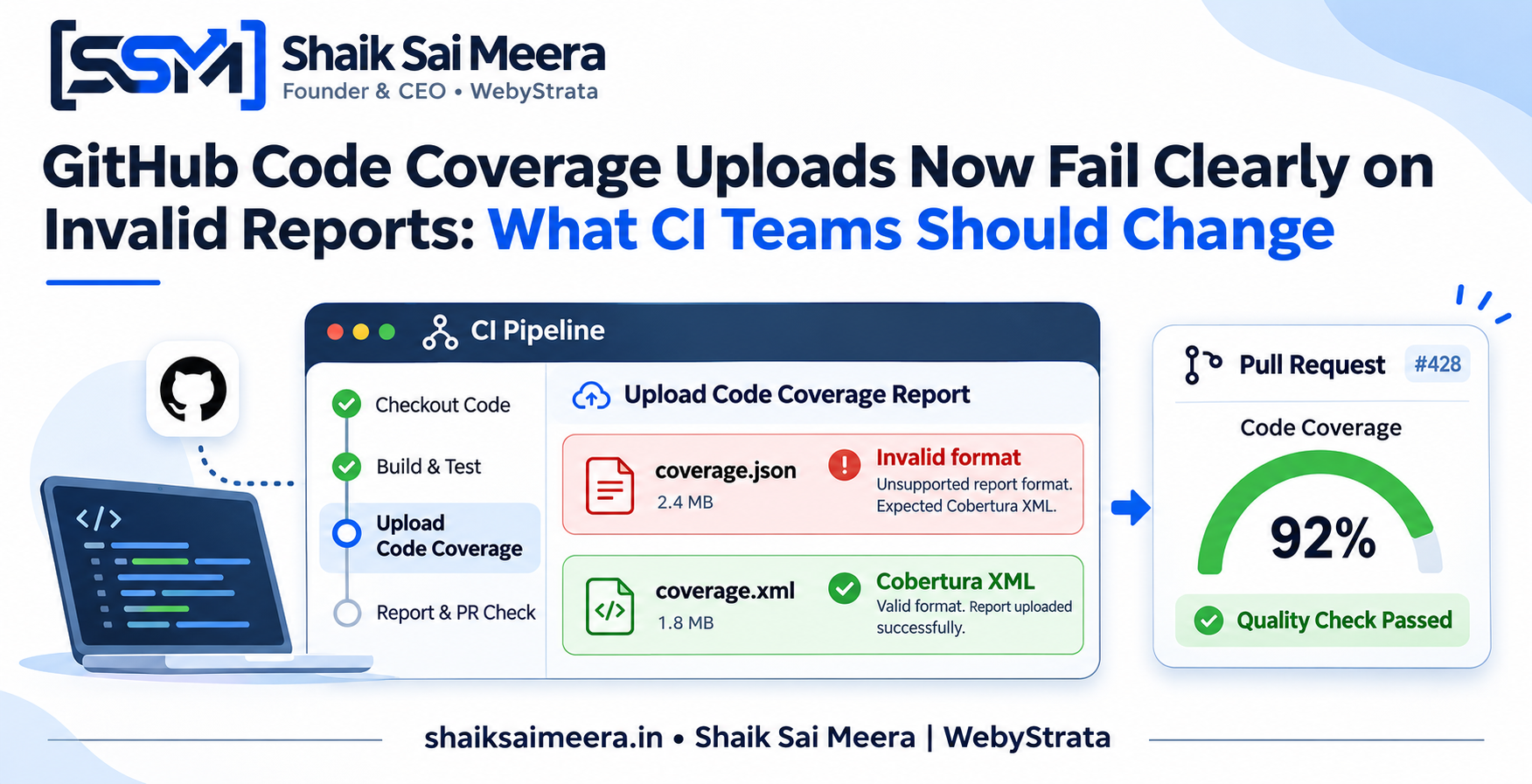
GitHub has changed a small but important part of the code-quality workflow: the code coverage upload action now checks that a report is in Cobertura XML format and fails the workflow when it is not. Previously, a job could appear to upload coverage successfully even though no coverage was shown on pull requests. The new behavior makes the pipeline noisier in the short term, but it closes a more dangerous failure mode: a green-looking step that quietly leaves reviewers without coverage data.
GitHub announced the change on November 23, 2026 (India Standard Time reference: November 23, 2026). It applies to GitHub Enterprise Cloud and GitHub Team, including Enterprise Cloud with data residency, and is not available on GitHub Enterprise Server. For CI maintainers, the main task is to treat coverage generation and coverage upload as one contract: the test framework must produce the format the upload action expects, and the workflow must fail loudly when that contract is broken.
What changed in the workflow
The upload-code-coverage action now verifies the incoming report. If the file is not a supported Cobertura XML report, the upload step fails and the Actions log explains the problem. GitHub’s example message is direct: the file is not a Cobertura XML report and the workflow should provide a Cobertura XML report instead.
That change matters because many tools can produce coverage in several formats. A test runner may emit JSON, LCOV, HTML, JaCoCo XML, OpenCover XML, or Cobertura XML depending on configuration. A file named coverage.xml is not automatically a Cobertura report. It can still be valid XML while using a different schema. The action is validating the format, not merely checking the file extension.
GitHub also made processing more forgiving for valid Cobertura reports. Minor structural issues no longer cause the whole report to be rejected, and individual lines without a usable line number or hit count can be skipped instead of discarding the entire report. In other words, invalid format becomes an explicit configuration failure, while small imperfections inside an otherwise valid report are handled more gracefully. The official GitHub Changelog entry describes both sides of the change.
Why silent coverage failures are costly
Coverage is often treated as a pull-request signal rather than a build artifact. Reviewers use it to ask whether a new branch, bug fix, or security-sensitive path has tests. When an upload step says “success” but no coverage appears, the team may assume the repository has no coverage gap—or may simply stop looking at the signal.
A visible failure is healthier. It moves the problem to the point where the workflow still has context: the test command, the generated file, the runner image, and the commit that created it. The alternative is discovering later that pull requests have had incomplete coverage reporting for weeks.
The change also helps platform teams distinguish two different failures. A test suite can pass while coverage publishing fails. That should not necessarily block a production artifact, but it should block or alert the quality gate that depends on coverage. Teams can now make that policy explicit instead of allowing a misleading upload step to pass.
A practical migration example
Imagine a Python project whose tests run with coverage.py. The workflow currently writes coverage.json, then passes that file to the GitHub coverage action. Tests are green, the upload step is green, and pull requests show no coverage details.
The correct fix is not to rename coverage.json to coverage.xml. The project should configure coverage.py to emit Cobertura XML, then point the action at that generated file. The relevant shape is:
coverage run -m pytest
coverage xml -o coverage.xml
# configure upload-code-coverage to read coverage.xml
The same principle applies to JavaScript, Java, Go, .NET, and other ecosystems. First identify which coverage reporter your test framework supports. Then configure the reporter to produce Cobertura XML, confirm that the file exists in the runner, and inspect a sample report before relying on pull-request annotations.
A useful migration check is to run the workflow on a branch with a deliberately invalid report. The action should fail and the log should explain the expected format. Then run it with a valid Cobertura file and confirm that the pull request receives the expected coverage result. This validates both the failure path and the success path.
What CI teams should change now
- Find every upload step. Search workflow files for
upload-code-coverage, coverage artifacts, and reusable workflows. Do not assume only the main branch uses the action. - Trace the report producer. Record which command generates the report and which format it actually writes. Extensions and filenames are not enough; inspect the root element and schema when in doubt.
- Make the handoff explicit. Use a stable output path such as
coverage.xml, upload it as an artifact when debugging, and pass the same path to the coverage action. - Separate test health from reporting health. Decide whether a coverage-upload failure should fail the whole build, block merging, create an alert, or remain advisory. The decision should be visible in branch protection and team documentation.
- Test reusable workflows. A centralized workflow can hide assumptions about runner images, working directories, report paths, and language-specific commands. Add a fixture repository or CI test that exercises the action with both valid and invalid inputs.
Trade-offs and edge cases
The immediate trade-off is pipeline churn. Repositories that depended on the old permissive behavior may see new failures, especially where a third-party tool emits a non-Cobertura format or where the report path is wrong. That is an intentional cost: a broken quality signal should be visible.
Teams should also avoid assuming that “valid Cobertura” means “complete coverage.” A report can be structurally valid but omit packages, mis-map source paths, or represent only part of a test matrix. Multi-language repositories may need one report per language or a conversion step that merges reports carefully. The action’s format check improves transport reliability; it does not validate the test strategy or the semantic accuracy of the numbers.
Finally, this update does not extend the feature to GitHub Enterprise Server. Organizations running that product should verify their own action versions, runner behavior, and coverage integrations rather than assuming the same platform-side validation is present.
The broader lesson
CI systems are most trustworthy when they fail at the boundary between a producer and a consumer. A test tool produces a report; a quality platform consumes it. If the format contract is implicit, a green workflow can still produce no usable insight. GitHub’s update makes that contract explicit for code coverage and gives teams a clearer repair path.
After the migration, measure more than whether the action passes. Check that pull requests display coverage, that changed files are mapped to the right source paths, and that coverage results represent the intended test matrix. A loud failure is useful—but a visible, accurate quality signal is the real outcome.
This article is a general information summary based on the cited public sources. It is not legal, cybersecurity, or compliance advice.
Related Articles