Tech Insights
Anthropic’s Drug-Development Update Shows AI Moving From Molecules to the Whole Workflow
Anthropic’s latest life-sciences update describes Claude moving beyond molecule design into lab work, manufacturing documentation and clinical planning. The results are early, but the workflow shift is the more important technology story.
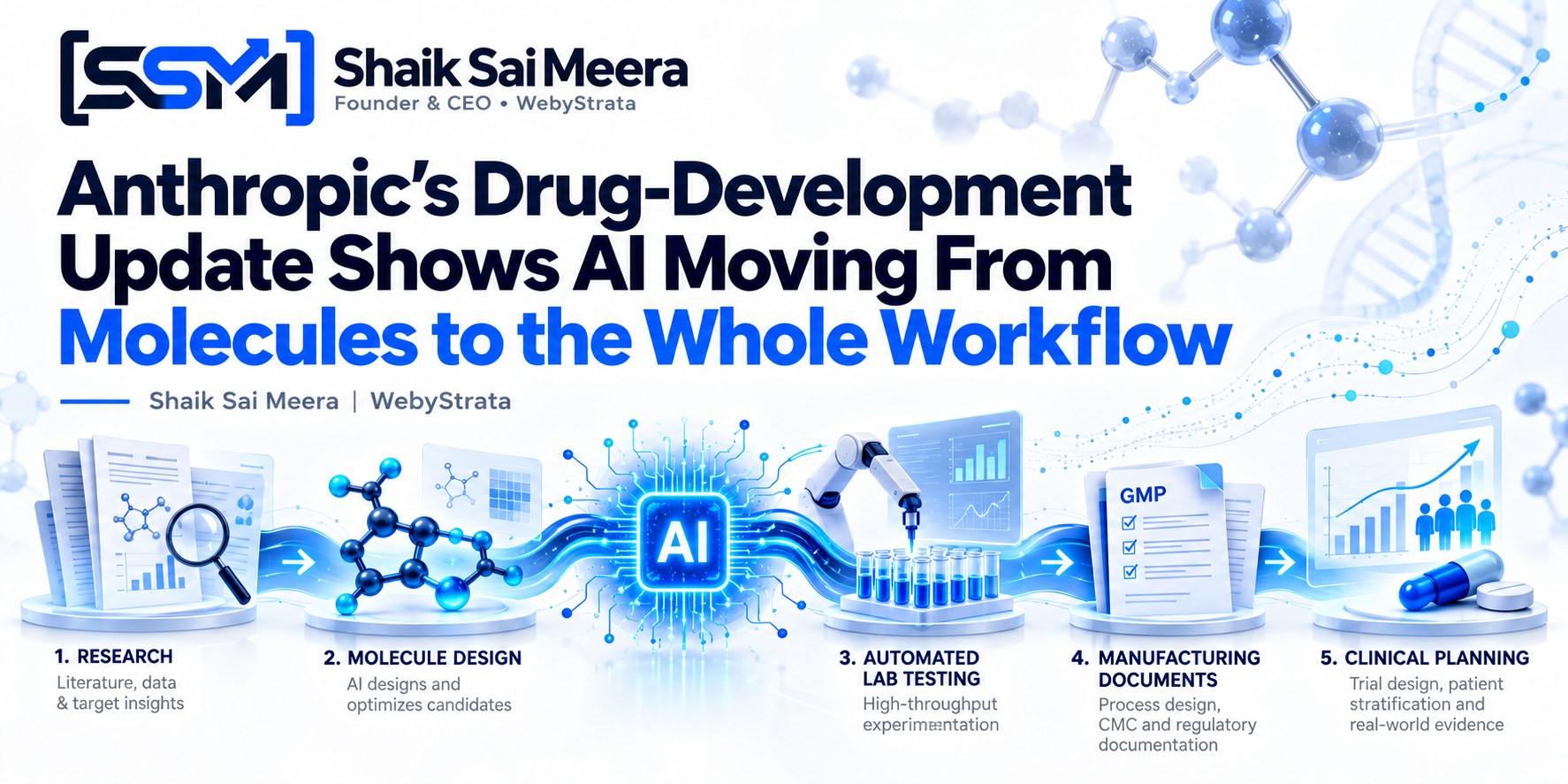
Much of the AI-and-drug-discovery conversation has focused on a single moment: asking a model to suggest a promising molecule. Anthropic’s latest life-sciences update describes a larger ambition. The company says Claude is being used across research, molecule design, automated laboratory work, manufacturing documentation and clinical planning, with the aim of reducing bottlenecks throughout the development process.
Anthropic published the update on October 27, 2026, after working with six organizations involved in drug development and beginning some programs of its own. The company’s official research update presents the work as early progress rather than a finished system. Most of the research described is preclinical, and the results are reported by Anthropic and its partners rather than by a single independent benchmark.
The technology story is still significant because it changes where AI is being placed. Instead of treating drug development as a molecule-generation problem, Anthropic is treating it as a chain of connected decisions and operations.
The before-and-after is a workflow change
In the narrower model of AI-assisted discovery, researchers use a system to propose candidate molecules or proteins. Scientists then evaluate those candidates with laboratory experiments, revise the designs and continue the cycle. The model is useful, but it occupies one stage in a much larger process.
Anthropic’s update describes Claude being connected to more of that process. The company says its partners are using the model to help identify targets, design and optimize molecules, analyze lab results, prepare manufacturing records, draft regulatory documents and assess clinical-trial plans. That does not mean Claude replaces scientists or turns a prompt into an approved medicine. It means the system is being tested as a layer that can carry context across several kinds of work.
This distinction matters for enterprise AI. The hardest part of a specialized workflow is often not generating one answer. It is moving reliable information between teams, tools, experiments and decisions without losing the assumptions that shaped the work.
What the case studies show
Anthropic highlights several examples. At Generate Biomedicines, six scientists used Claude Code to propose a shorter genetic instruction for a cancer-treatment approach. Anthropic says one design was about 70% shorter and, in lab tests reported by the company, helped immune cells produce roughly 10 times as many receptors while remaining active for longer.
At Divergence Labs, Anthropic says Claude generated about 35,000 antibody designs in roughly a month for a food-allergy treatment concept. Early tests identified designs that bound to the target or appeared to dislodge it more effectively than the standard medication used for comparison. The company describes the next step as combining those functions into a single design.
At BigHat Biosciences, Claude was connected to lab data while scientists worked on antibody fragments. Anthropic says the laboratory made and tested about 1,010 variants over 10 weeks. The best versions reportedly improved binding, heat stability or resistance to clumping compared with the original candidates. The example is less about a chatbot producing an answer and more about a model helping a team decide which experimental loop to run next.
The workflow also extends beyond molecular design. Anthropic says Enveda connected manufacturing documents to Claude so the system could flag possible issues. Across 1,061 pages, it caught the 11 issues human reviewers had already found and flagged seven more, while reducing the reported review time by 89%. Anthropic also says Claude drafted two regulatory documents, one in four hours compared with about three months by hand. Those are company-reported results, so the methods and review conditions matter as much as the headline numbers.
Why the paperwork example may be as important as the molecule examples
Drug development is constrained by administrative and operational work as well as scientific discovery. A promising candidate still has to be manufactured consistently, documented carefully and evaluated through a process that can withstand scrutiny. If AI helps with only the first design step, much of the timeline remains untouched.
The Enveda example illustrates a different opportunity: using a model to connect large bodies of technical documentation, identify inconsistencies and prepare a first draft for human review. That kind of work is not as visually dramatic as generating a new molecule, but it may be easier to integrate into an existing process because the output can be compared against source records and reviewed by specialists.
Anthropic’s work with Bristol Myers Squibb points toward another layer. The company says BMS is using Claude to analyze proprietary data, create a clinical-study plan and estimate the likelihood of trial success, with broader work planned for 2027. The important shift is from a research assistant that proposes designs to a system that helps teams reason about options across an entire program.
The architecture lesson for AI builders
These examples suggest an architecture with three connected parts: a model that can reason over domain material, tool integrations that connect the model to live systems, and human checkpoints where scientific or operational decisions are accepted, rejected or revised.
Anthropic says BigHat connected Claude to its lab data system, while Enveda built a system linking manufacturing documents to the model. Those integrations are what make the workflow examples different from a general-purpose chat session. The model can work against an organization’s actual records and experimental history, but that also increases the importance of permissions, data boundaries, versioned inputs and clear audit trails.
There is a trade-off. A model that sees more of the workflow can be more useful, but it can also carry errors or outdated assumptions from one stage into another. The best results therefore depend on interfaces that make source material visible, preserve uncertainty and keep experts involved at the points where an incorrect interpretation would change the direction of the program.
What the update does not prove
Anthropic is careful to describe the work as early. The company says most of the programs are still preclinical and that positive early results do not guarantee effective medicines. A laboratory result is not the same as a clinical outcome, and an improved document-review workflow is not the same as a validated research conclusion.
The update also comes from a model developer describing its own partnerships and research. Readers should treat the numbers as reported claims that require examination of the linked technical reports, experimental protocols and later independent results. The strongest technology signal is not that AI has solved drug development. It is that model vendors are beginning to test AI inside long, multi-stage systems where value depends on coordination rather than one impressive output.
The broader technology takeaway
Anthropic’s update points to a future in which specialized AI is measured by how well it helps a team move through a workflow, not only by how well it answers a question. In drug development, that workflow runs from target research to design, lab validation, manufacturing, documentation and clinical planning. In other industries, the same pattern could connect research, engineering, operations and decision support.
The memorable part of this announcement is not a promise that a model will invent a cure on demand. It is the quieter idea that AI may become useful when it is given enough context to understand where a process is stuck—and enough structure to help without hiding the uncertainty. The next test is whether these early integrations continue to produce results that hold up outside the announcement and inside the real work of science.
Editorial note: This article is a general information summary based on the cited public sources. It is not legal, cybersecurity, or compliance advice.
Related Articles