Tech Insights
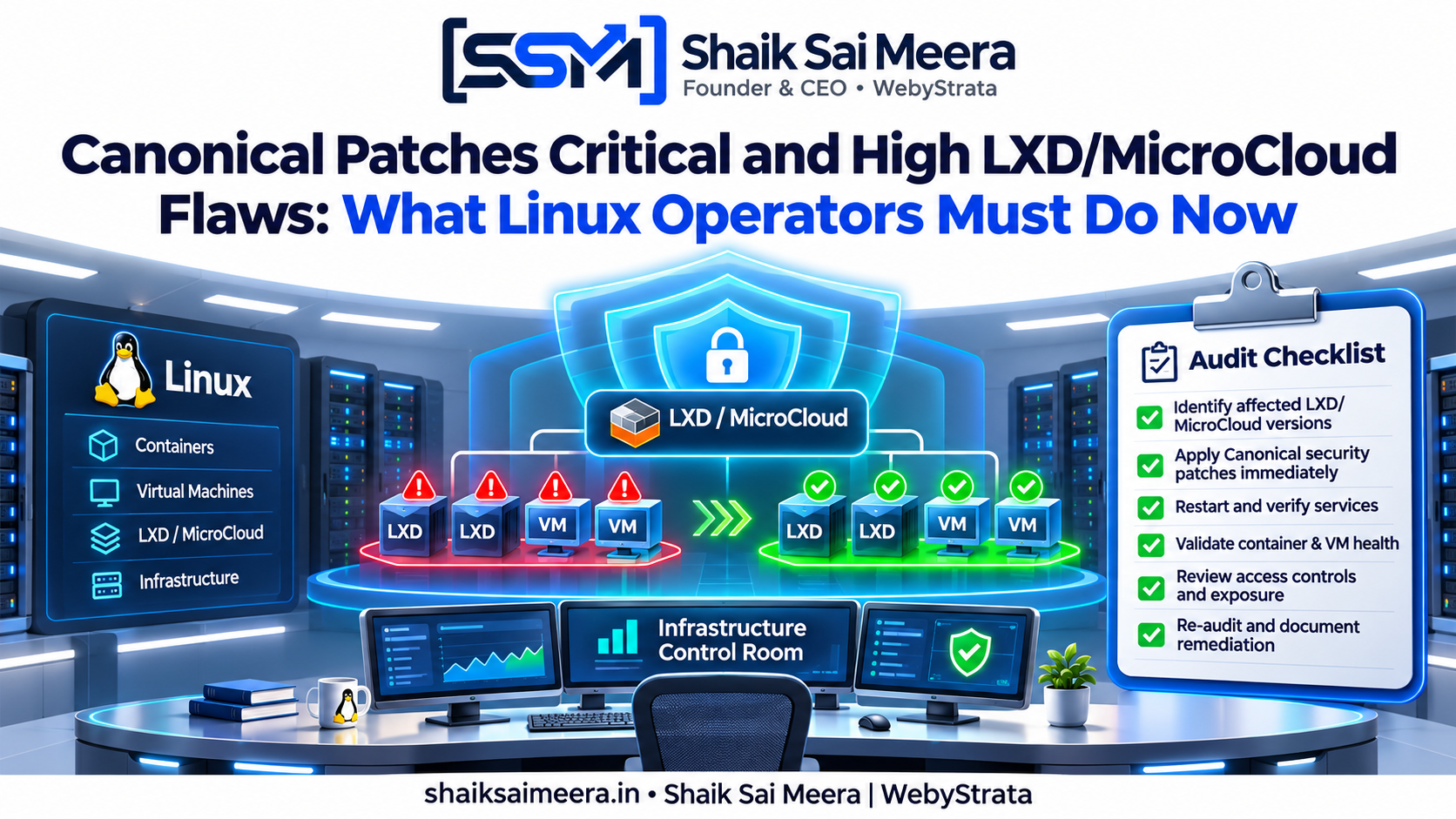
Canonical Patches Critical and High LXD/MicroCloud Flaws: What Linux Operators Must Do Now
Canonical has released a coordinated set of LXD security fixes after receiving an unusually large batch of vulnerability reports from the Incus project and independent researchers. The advisory, posted at about 9:41 PM India…

Canonical has released a coordinated set of LXD security fixes after receiving an unusually large batch of vulnerability reports from the Incus project and independent researchers. The advisory, posted at about 9:41 PM India Standard Time on November 26, 2026, says 16 Critical and 20 High severity issues were prioritized and backported to the supported LXD long-term releases. Several of the Critical issues carry CVSS scores of 9.9.
For teams using LXD or MicroCloud as a container and virtual-machine platform, this is not a routine “update when convenient” notice. The affected paths touch image imports, backups, storage volumes, migrations, device handling, authorization, networking, and identity. In the wrong deployment, a restricted project user could cross the boundary from a tenant or container operation to host-level access.
What Canonical fixed
Canonical’s security advisory lists fixes for LXD 4.0.16, 5.0.12, 5.21.10, and 6.10.2. At the time of the announcement, the versions were available through the /candidate channels and were being validated before promotion to /stable. Operators should check the channel and snap revision actually installed on each host instead of assuming that an update has already reached every node.
The vulnerability set is broad, but the practical risk falls into a few recognizable groups:
- Host-file and device access: crafted image, backup, storage, or transfer content could exploit symlinks, device nodes, hard links, named pipes, or path traversal to read or overwrite host files and devices as root.
- Container and VM escape: unsafe helper behavior, configuration injection, migration flows, and low-level device settings could allow restricted users or container contexts to execute code as host root or weaken confinement.
- Cross-project access: missing authorization checks could expose or alter another project’s backups, images, volumes, console output, or recorded command results.
- Secrets and identity: operations, events, API responses, and logs could disclose credentials or migration secrets. An OIDC validation issue could accept a token intended for another application, creating an impersonation path.
- Network control: malformed network, DNS, bridge, and ACL input could affect other tenants’ interfaces, traffic, DNS records, or host-side DHCP behavior.
Several issues are especially serious because they do not require a full administrator account. The advisory describes restricted project users reading or modifying host data, reaching host devices, or obtaining host-root execution through crafted content. That changes the threat model for shared LXD environments: project restrictions are useful controls, but they cannot substitute for timely patching when the control plane itself has unsafe input paths.
What operators should do first
Start with an inventory, not a blind restart. On every LXD host and MicroCloud member, record the installed snap channel, revision, LXD version, cluster membership, storage backends, identity provider, and whether untrusted teams can create projects, upload images, restore backups, attach devices, or initiate migrations. Include lab and disaster-recovery nodes; an overlooked standby can become the weakest entry point when workloads move.
Then apply Canonical’s update instruction:
sudo snap refresh lxdAfter the refresh, verify the installed version and snap revision, restart or roll the service according to the cluster’s maintenance procedure, and test a representative container, VM, image pull, backup restore, storage-volume operation, and migration. A patch is only useful if the node running the workload received it and the control plane still behaves correctly afterward.
MicroCloud operators should update the corresponding LXD version as well. The advisory says the other MicroCloud components do not require an update for this set of fixes, but that should not be interpreted as permission to skip version validation across the cluster.
Plan for the Entra ID breaking change
The OIDC hardening introduces an operational wrinkle for deployments using Microsoft Entra ID. After the update, administrators must reconfigure the Entra ID tenant to match the updated requirements. Users who authenticated through the LXD UI should regain access after that change, but users who only used OIDC through the CLI may need their OIDC identities deleted so LXD can recreate them on the next login. If the deployment does not use IdP groups, group membership may also need to be restored.
This is a good reason to schedule the upgrade with an identity administrator present. Before touching production, capture the current tenant configuration, LXD group mappings, break-glass access, and a tested local administrator path. Avoid discovering during an outage that the only available operator session depends on the identity flow being changed.
A practical example
Consider a hosting company that gives each customer a restricted LXD project. Customers can upload images and restore backups, while a small platform team manages the host. The team might initially classify the exposure as “tenant-to-tenant,” but the patched issues show why the review must include the host boundary. A crafted backup could target a host path; a leaked operation event could expose a migration secret; a permissive device profile could widen the blast radius.
The safe response is to freeze new image and backup imports briefly, snapshot evidence and logs, patch every cluster member, validate identity access, and then review which project permissions are truly needed. Rotate credentials that may have appeared in events, logs, exports, or environment variables. Review recent project activity for unusual image uploads, backup restores, device attachments, migration requests, or access to another project’s resources. Do not wait for proof of exploitation before reducing unnecessary permissions.
Trade-offs and remaining work
The immediate trade-off is service disruption: patching a clustered control plane, retesting storage, and reconfiguring Entra ID can take longer than a normal snap refresh. That cost is smaller than accepting a possible host compromise, especially on shared infrastructure. One known regression also matters: LXD 5.21.10 can fail to start containers when NVIDIA GPUs are passed through using a CDI identifier. GPU-heavy teams should include a non-production GPU test in the rollout and watch for the next point release.
Canonical says Moderate and Low severity fixes will be addressed later in the 6.10 LTS line. Operators should therefore treat this release as the urgent first phase, not the end of the hardening program. Keep project permissions narrow, isolate management APIs, limit who can view operation events, protect backups as sensitive control-plane data, and maintain an independent recovery path outside the affected cluster.
Takeaways
- Patch all LXD and MicroCloud nodes to the fixed LTS versions, then verify versions and snap revisions.
- Test image, backup, storage, device, identity, and migration workflows after the upgrade.
- Prepare for Entra ID reconfiguration and preserve a tested break-glass administrator path.
- Review logs and rotate secrets that may have been exposed through operations, events, exports, or environment data.
- Assume restricted project users are in scope for the risk review; do not rely on project isolation alone.
This article is a general information summary based on the cited public sources. It is not legal, cybersecurity, or compliance advice.
Related Articles