cybersecurity
Cloudflare Zero Wire Turns Critical Vulnerability Response Into a Shared Briefing
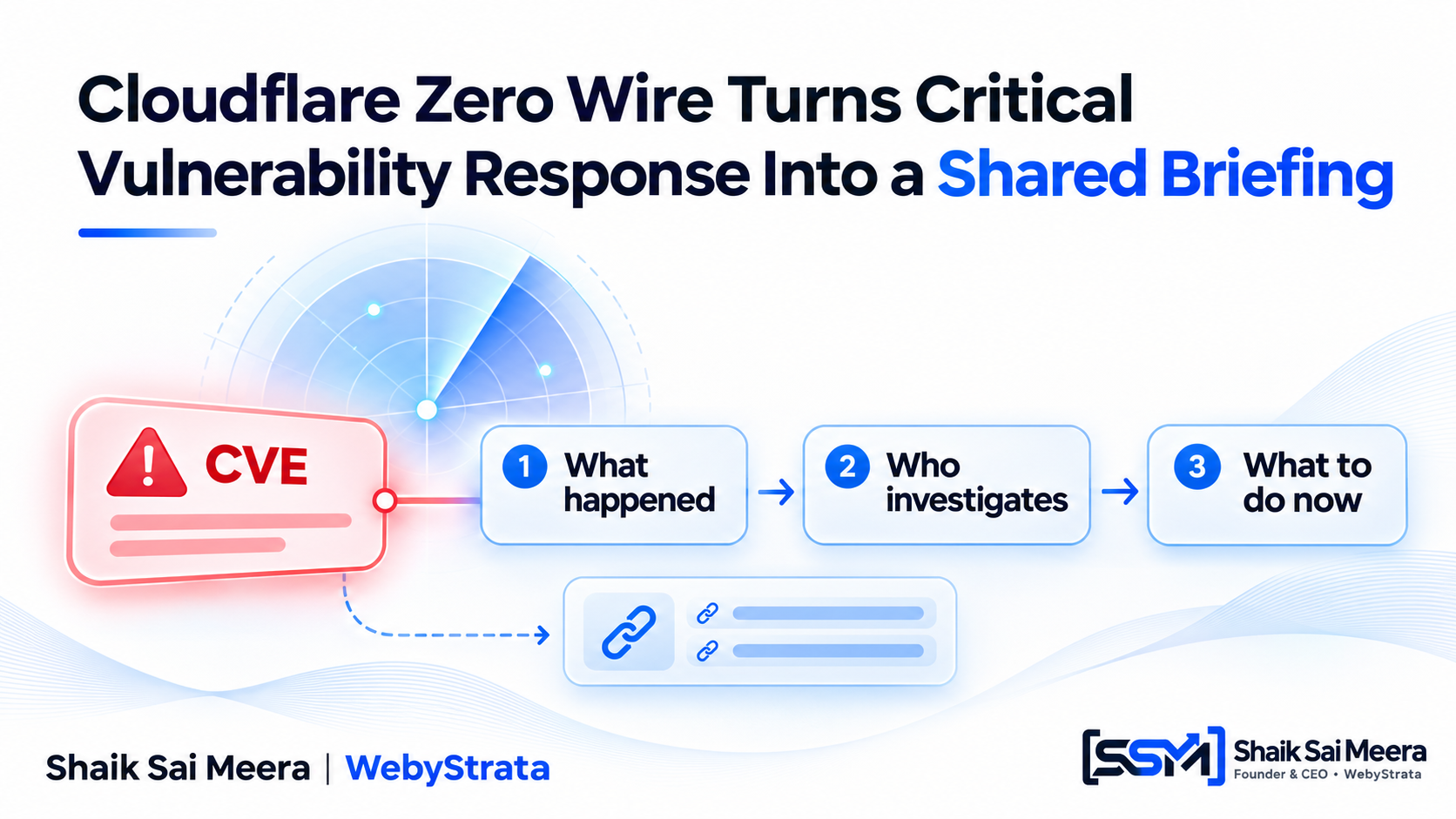
Cloudflare has introduced Zero Wire on Cloudflare Radar, a public vulnerability intelligence feed designed to connect critical vulnerability context with practical investigation steps.
When a critical vulnerability is disclosed, the first challenge is often not finding the advisory. It is turning a fast-moving stream of technical material into a shared understanding that security, infrastructure and business teams can use at the same time.
On November 3, 2026, Cloudflare introduced Zero Wire, a public vulnerability intelligence feed inside Cloudflare Radar. In its official announcement, Cloudflare says the service is designed to explain significant vulnerabilities in plain language, identify who should investigate them, outline what to do next and link to the evidence and vendor guidance.
That makes Zero Wire different from a vulnerability database that simply lists identifiers and severity scores. Cloudflare is positioning it as a briefing layer: a place where teams can start with the operational question, “What does this mean for us, and which team needs to act?”
The problem is coordination, not only discovery
A security team may receive an alert about a new vulnerability, then open a vendor advisory, a research post, a CVE record and an exploitation report. Infrastructure teams may be trying to map the affected software to hosts, containers or managed services. Leadership may ask whether exploitation is known and whether a mitigation is already in place.
All of those questions are reasonable, but they are answered by different sources. A vendor advisory is usually the authority for affected versions and fixes. A threat report may provide evidence of exploitation. A network provider may have observations about traffic patterns. A vulnerability identifier helps connect records, but it does not by itself produce an action plan.
Cloudflare’s Zero Wire concept brings those pieces into a briefing format. The value is less about replacing the underlying sources and more about reducing the time needed to assemble the first accurate picture.
How the briefing format works
Cloudflare says each briefing includes a plain-language overview, the teams that should investigate, recommended actions and links to supporting evidence. Briefings can be searched by CVE or issue name, and technology tags help readers find related entries.
The homepage separates issues into “Needs attention” and “Reference.” The first category is meant for issues requiring active assessment or action, including cases with known exploitation or changing guidance. The second keeps stabilized briefings available for reference. Cloudflare notes that moving an item to Reference does not mean every affected system has been fixed; it only describes the state of the guidance.
That distinction is useful for organizations with long remediation cycles. A vulnerability can stop being a headline while remaining relevant to a system that has not been updated. Status labels should therefore be read as context, not as a substitute for checking a specific deployment.
Why the focus is on critical Internet-facing software
Cloudflare says Zero Wire will not attempt to catalog every CVE. Its focus is critical vulnerabilities in Internet-facing software, including web applications, runtimes, libraries and exposed services where traffic controls may sometimes help reduce exploitation risk.
This is a practical boundary. Security teams already have vulnerability scanners, asset inventories and vendor notification channels. A focused public feed can add more value when it helps teams prioritize the issues most likely to require cross-functional attention.
The scope also reflects an important limitation. A vulnerability can be serious even when a Cloudflare-specific control is irrelevant. Some issues require a vendor update, a runtime change, a configuration adjustment or a replacement of the affected component. Cloudflare explicitly says that a dedicated Cloudflare protection is not required for an issue to appear in Zero Wire.
Evidence is kept separate from interpretation
One of the strongest parts of the announcement is the separation between what is known and what remains uncertain. Cloudflare says briefings can distinguish vulnerability severity from evidence of active exploitation. Those are related but different questions.
A severe vulnerability may not have confirmed exploitation in the available evidence. Conversely, a lower-severity issue may be heavily targeted in a particular environment. A briefing that records both the technical issue and the evidence behind the response helps teams avoid treating a severity number as a complete risk assessment.
Cloudflare also warns that traffic observations are not a count of compromised systems or successful exploits. Requests matching a Web Application Firewall rule show activity that may deserve attention, but they do not prove that a particular organization was breached. The distinction matters because a signal can be useful without being conclusive.
The AI prompt is an investigation aid, not an automatic scan
Zero Wire includes a pre-compiled prompt that can be used with an AI agent to assess potential impact on an organization’s infrastructure. Cloudflare describes the prompt as asking for a read-only assessment of deployed software, relevant fixes, exposure, compensating controls, evidence for each asset, unknowns and next actions.
The wording “read-only” is important. Copying the prompt does not scan or change systems by itself. The quality of the result still depends on what inventory, version and configuration information the organization makes available to the agent. An incomplete asset list can produce an incomplete answer, even when the prompt is well structured.
For teams experimenting with AI-assisted security work, the prompt offers a repeatable starting format. It encourages the agent to show evidence and unknowns instead of returning a confident yes-or-no conclusion. Human review remains necessary before changes are made.
What a team can take from the workflow
The Zero Wire approach suggests a simple incident-response rhythm for critical vulnerability work. First, identify the software, versions and owners that need investigation. Next, compare the vendor’s applicability and remediation guidance with the organization’s actual deployment. Then separate confirmed facts from assumptions, record any temporary controls and assign an owner for the next update.
That rhythm can help prevent a common failure mode: treating the first alert as the final answer. A team may know that a vulnerability is critical but still not know whether it is present, whether a managed provider has already patched it, or whether a temporary control covers the traffic that matters.
Cloudflare’s own guidance reinforces the same point for WAF protections. A traffic rule can be a compensating control for covered requests, but it is not a replacement for fixing vulnerable software and cannot undo actions already performed at the origin.
What Zero Wire does not replace
A public intelligence feed cannot know the complete state of every organization. It does not replace asset inventory, software composition analysis, vendor communications, patch management or an internal record of exceptions. It also cannot determine whether a specific company is affected without organization-specific evidence.
Its role is narrower and useful: make the first briefing faster, clearer and easier to share. The most valuable result is not a dramatic headline. It is a common starting point where security leaders, engineers and system owners can see the same issue, the same evidence and the same next questions.
As vulnerability discovery accelerates, that shared briefing layer may become as important as the database entry itself. The teams that respond well will be the ones that can move from disclosure to ownership, evidence and action without losing the differences between what is known, what is suspected and what still needs to be checked.
This article is a general information summary based on the cited public sources. It is not legal, cybersecurity, or compliance advice.
Related Articles