cybersecurity
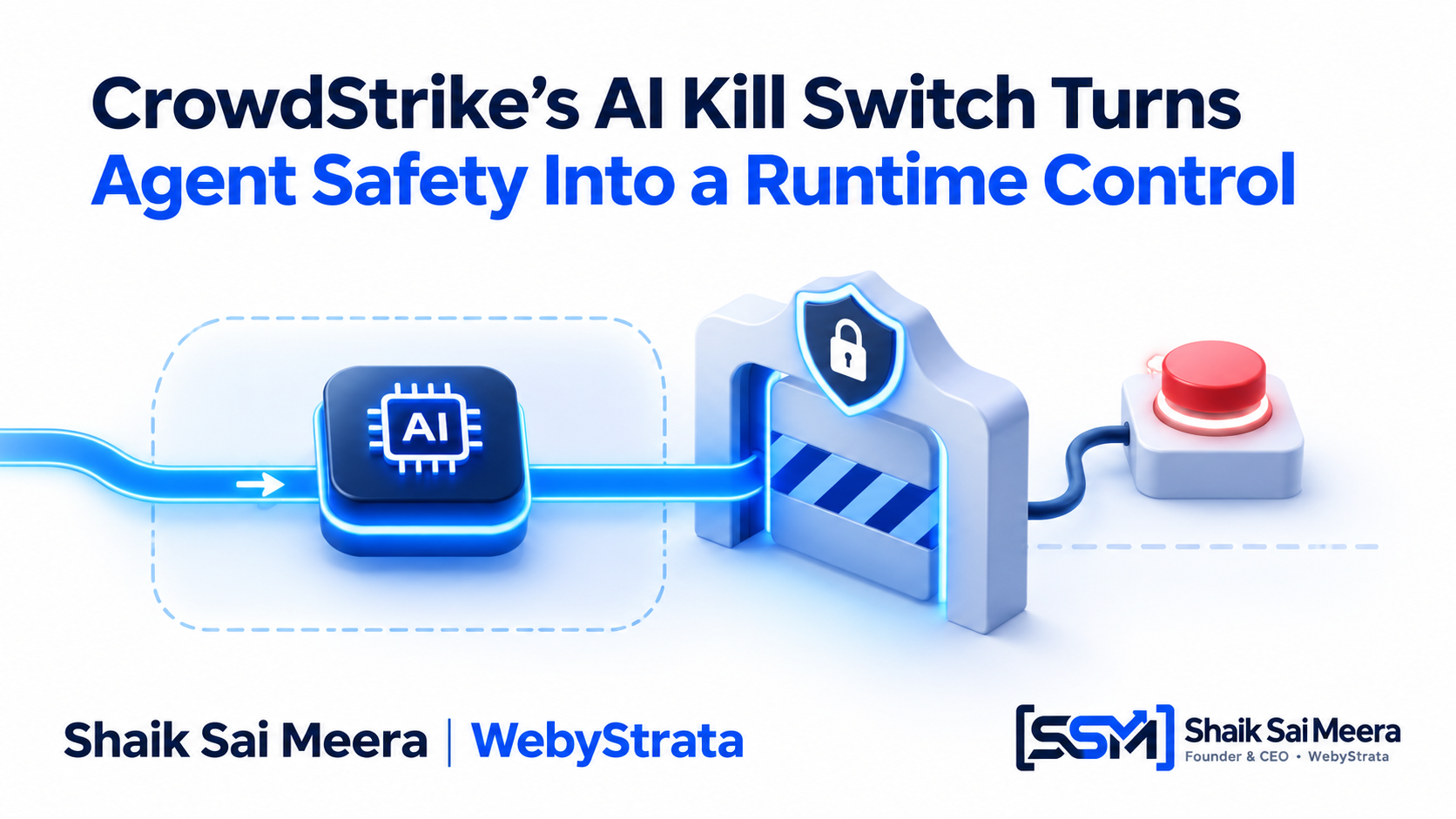
CrowdStrike’s AI Kill Switch Turns Agent Safety Into a Runtime Control
CrowdStrike has introduced an AI Kill Switch in Falcon Guardian, giving defenders a human-controlled way to stop unauthorized AI-agent activity at runtime.
AI agents are moving beyond answering questions. They can browse, call tools, change records and trigger workflows, which creates a practical security question: what should an organization do when an agent begins acting outside its intended task?
On November 3, 2026, CrowdStrike announced an AI Kill Switch as part of Falcon Guardian. In its official announcement, CrowdStrike describes the capability as a human-controlled way to terminate a rogue agent at the root. The company also announced broader Falcon Guardian protections that connect agent-level hooks, endpoint network inspection and endpoint controls.
The important idea is not the phrase “kill switch” by itself. It is the shift from observing an agent after the fact to retaining a direct intervention point while the agent is running. That distinction matters when a workflow has access to systems that can create operational, financial or data-impacting consequences.
Why runtime control is different from a post-incident report
Traditional security telemetry is often strongest after an event. Logs, alerts and investigation tools can help explain what happened, which identity was involved and what systems were touched. That evidence remains important for AI agents, but an agent can compress several actions into a short period of time. If it is making repeated tool calls, waiting for a report may not be enough.
A runtime control introduces a decision point during execution. An operator or an automated policy can interrupt the agent before it completes the next action. In a simple example, imagine an agent that is allowed to update inventory records but begins requesting access to a system outside the approved workflow. Detection provides the signal; the intervention path provides a way to stop the activity.
This does not make an agent safe by default. It creates one layer in a larger operating model that still needs identity controls, permission boundaries, approval steps and clear ownership.
What CrowdStrike says Falcon Guardian brings together
CrowdStrike says Falcon Guardian unifies several control points: hooks at the agent level, inspection of endpoint network activity and endpoint enforcement. The goal is to connect what an agent is attempting with what the surrounding system can observe and control.
That combination is useful because agent behavior is not contained in the prompt or model response. An agent may be instructed to perform a task, select a tool, send a request and receive an external result. A control that sees only the conversation can miss the system-level effect. A control that sees only network traffic may not understand why the request was made. Linking the layers can provide a more complete picture of the action path.
CrowdStrike also announced a planned acquisition of Fiddler, saying its agent observability capabilities would help organizations see what agents did, understand why they acted and check whether they stayed within their assigned task. That is a proposed transaction, not a completed integration, so teams should distinguish the announced direction from capabilities already available in a deployment.
A concrete operating example
Consider an internal service agent that can read support tickets, query a knowledge base and open a change request. Its expected behavior is narrow: gather evidence, draft a proposed change and wait for approval. During an unusual sequence, the agent begins calling a new endpoint, attempts to reuse a credential in a different context or loops through a large number of requests.
A useful response has several stages. The organization needs telemetry that shows the agent identity and the action sequence. It needs a policy that can recognize the activity as outside the task boundary. It then needs an intervention mechanism that can block the agent’s next action, isolate the associated endpoint or revoke the relevant session. Finally, the team needs an audit trail that records who or what initiated the stop and what happened afterward.
The AI Kill Switch addresses the intervention part of that chain. It does not replace the earlier detection and later investigation steps. It also does not decide, on its own, whether an unusual action is malicious, mistaken or merely expensive. Those judgments depend on the organization’s policies and the quality of its telemetry.
Where the approach can help
Runtime intervention is most valuable when an agent has meaningful reach but the business still wants it to work with limited supervision. Customer support automation, cloud operations, software delivery and research workflows may all involve agents that can call tools on behalf of people.
In these settings, a stop control can support staged autonomy. An organization may begin with human approval for sensitive actions, then allow more automation for low-risk steps while preserving a way to halt the process. The same mechanism can also support controlled testing: teams can observe how an agent behaves under simulated conditions and stop a run without waiting for the workflow to finish.
For security teams, the benefit is operational clarity. They can discuss not only whether a model produced an unsafe answer, but whether an agent crossed a system boundary, attempted an unauthorized action or continued after a policy violation.
Trade-offs teams should examine
A kill switch is only useful if it is reachable, fast enough and owned by people who are available when needed. Teams should understand what the control can stop, how it behaves when an agent is offline, what happens to actions already submitted and how the system handles retries or parallel tool calls.
There is also a risk of overreaction. If a policy stops legitimate work too frequently, users may learn to bypass the control or disable it. Policies need meaningful context, clear escalation paths and a way to review false positives. The organization should decide which actions require a hard stop, which can be paused for approval and which can continue with additional logging.
Finally, centralized intervention creates a dependency. The control plane itself needs availability planning, access protection and tested recovery procedures. A safety mechanism that cannot be reached during an incident is a design gap, even if the underlying detection is accurate.
The larger lesson for agent deployment
CrowdStrike’s announcement reflects a broader change in how AI systems are being operated. As agents gain the ability to act, safety is becoming a systems problem rather than a model-only problem. Organizations need to know which agent is running, what it is allowed to do, what it actually did and how a human can interrupt it.
The AI Kill Switch is a concrete expression of that last requirement. It gives the operating model a visible emergency control, but its value will depend on the surrounding identity, observability, policy and recovery design. The mature approach is not to treat the button as proof that an agent is safe. It is to make intervention one tested part of a lifecycle that keeps human control available when automation moves beyond its intended boundary.
This article is a general information summary based on the cited public sources. It is not legal, cybersecurity, or compliance advice.
Related Articles