Tech Insights
Deterministic Networking Comes to Low-Power Edge AI
Microchip has added EtherCAT and Time-Sensitive Networking capabilities to its PolarFire FPGA and SoC platform, targeting predictable industrial edge communication.
Industrial AI has a timing problem that ordinary networking does not always solve. A vision model may identify a defect quickly, but a robot, motor controller, or safety system still needs the result to arrive predictably. A network that is fast on average can be a poor fit when a control loop depends on bounded delay and consistent scheduling.
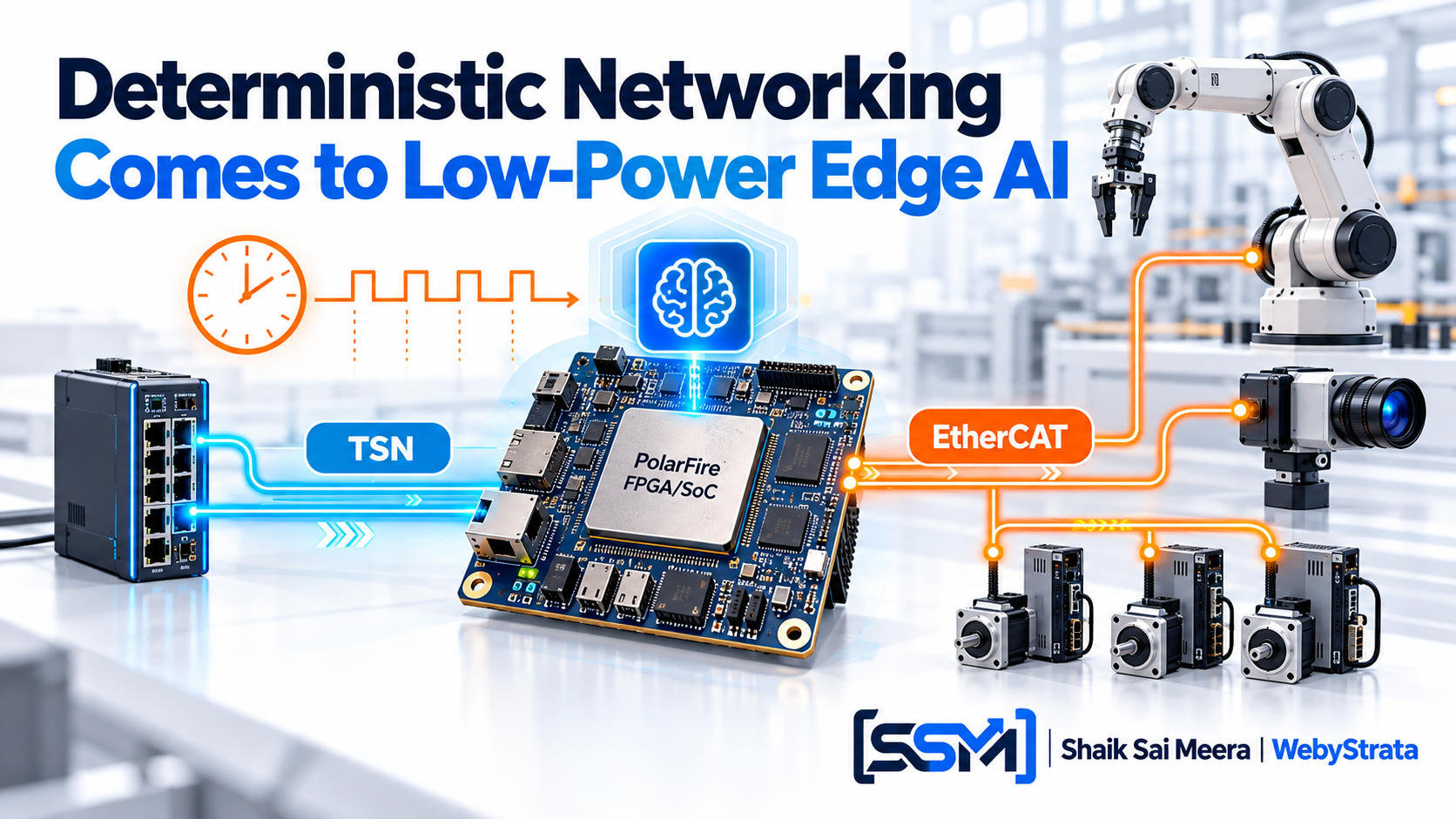
Microchip says it has expanded its PolarFire FPGA and SoC solution stack with EtherCAT and Time-Sensitive Networking (TSN) capabilities. In its October 29, 2026 announcement, the company positioned the update for industrial automation, robotics, machine vision, autonomous mobile robots, and other edge systems that need real-time communication with low power use.
What the update adds
The change brings two different networking approaches into the same FPGA and SoC platform. Microchip says Beckhoff EtherCAT IP is compatible with PolarFire FPGA and SoC devices, while Microchip’s TSN IP is supported on PolarFire FPGA SoCs.
EtherCAT is commonly used where many industrial devices must exchange control data with tight timing. TSN is a set of IEEE 802.1 Ethernet standards designed to make scheduled, time-aware traffic more predictable across an Ethernet network. The two technologies are not interchangeable in every design, but their inclusion gives engineers more options when they are connecting control, sensing, and computing functions at the edge.
Microchip says the EtherCAT capability supports 10/100/1000 Mbps connectivity, while its TSN solution enables deterministic 1 Gbps Ethernet using IEEE 802.1 standards. Those figures describe the networking capabilities of the solution stack; they do not guarantee the response time of a complete machine. The final behavior still depends on the FPGA design, endpoints, software, traffic mix, and control algorithm.
Why predictable timing matters more than peak bandwidth
In a conventional web application, a request that takes 8 milliseconds instead of 5 milliseconds may be acceptable. In an industrial motion-control loop, the important question can be whether a message always arrives within a known window. Jitter can make a system harder to tune, especially when multiple devices must coordinate movement or respond to sensor data at a defined point in time.
That is where deterministic networking fits. It is less about making every packet faster and more about giving traffic a controlled path through the system. A factory network may need to carry video, telemetry, control messages, maintenance traffic, and model outputs at the same time. A design that can schedule or prioritize time-sensitive traffic helps engineers keep the critical path understandable while other data uses the remaining capacity.
The before-and-after for an edge design
Before this expansion, a developer building a low-power industrial AI device might have had to combine a separate industrial-network controller, a processor for edge inference, and custom logic for device coordination. That can increase board complexity and make the timing relationship between sensing, inference, and actuation harder to reason about.
With EtherCAT and TSN capabilities available in the PolarFire solution stack, Microchip is offering a route to place networking, programmable logic, and edge processing closer together. The FPGA fabric can be customized around the application, while the SoC option can provide a processor environment for application software and control logic. The practical benefit is architectural flexibility, not a promise that every workload becomes simpler.
For example, a machine-vision system could receive camera data, run a compact classifier, and send a decision toward a motion controller without routing every step through a general-purpose server. A mobile robot could coordinate motor commands and sensor updates while reserving capacity for navigation or fleet telemetry. Those are design patterns; the right implementation still depends on the workload and the chosen field devices.
Where the trade-offs remain
Adding networking IP to an FPGA platform does not eliminate engineering work. Teams still have to validate clocking, buffering, packet handling, real-time operating behavior, device interoperability, and failure recovery. They also need to understand which functions belong in programmable logic and which belong in software.
There is a tooling trade-off as well. FPGA-based systems offer customization, but they require hardware-design skills, timing analysis, synthesis, verification, and a disciplined update process. An off-the-shelf industrial controller may be faster to deploy for a fixed machine, while a programmable platform may make more sense when a product needs a tailored data path, long lifecycle, or integration of several functions.
Security must remain part of the design. Microchip describes PolarFire devices as supporting features such as secure boot and anti-tamper protection, but those platform capabilities do not replace application-level credential management, network segmentation, software updates, or validation of the full device lifecycle.
A practical evaluation workflow
- Define the timing requirement. Measure the maximum acceptable latency and jitter for each control path instead of starting with a bandwidth target alone.
- Map the traffic classes. Separate motion control, sensor data, video, diagnostics, and maintenance traffic so the network design reflects their different priorities.
- Choose the protocol boundary. Decide where EtherCAT, TSN, ordinary Ethernet, and application software meet. Avoid assuming that one protocol should carry every workload.
- Prototype the complete loop. Test the camera or sensor, edge computation, network, actuator, and monitoring path together. A fast FPGA link cannot compensate for a slow downstream device.
- Test failure behavior. Measure what happens when a node disconnects, traffic spikes, clocks drift, or a model takes longer than expected to return a result.
Why this is a notable edge-computing move
Microchip’s update reflects a broader shift in edge computing: AI is moving closer to machines, but the network around the model must still behave like an industrial control system. A model that is accurate but arrives too late is not useful for every automation task.
EtherCAT and TSN support on a power-efficient FPGA and SoC platform gives developers a more direct way to explore systems where compute and communication are designed together. The real test will be in complete machine deployments, where predictable timing, power, safety, software maintenance, and interoperability all have to work at once. For teams building industrial AI devices, that is the value of the announcement: it makes the deterministic network part of the design conversation from the beginning.
This article is a general information summary based on the cited public sources. It is not legal, cybersecurity, or compliance advice.
Related Articles