Tech Insights
When a Default AI Model Changes, Your Experiment Changes Too
Google Cloud says Gemini 4 Argon will become the default model for new AlphaEvolve experiments on October 26, 2026. Here is why model defaults matter for cost, comparison, and reproducibility.
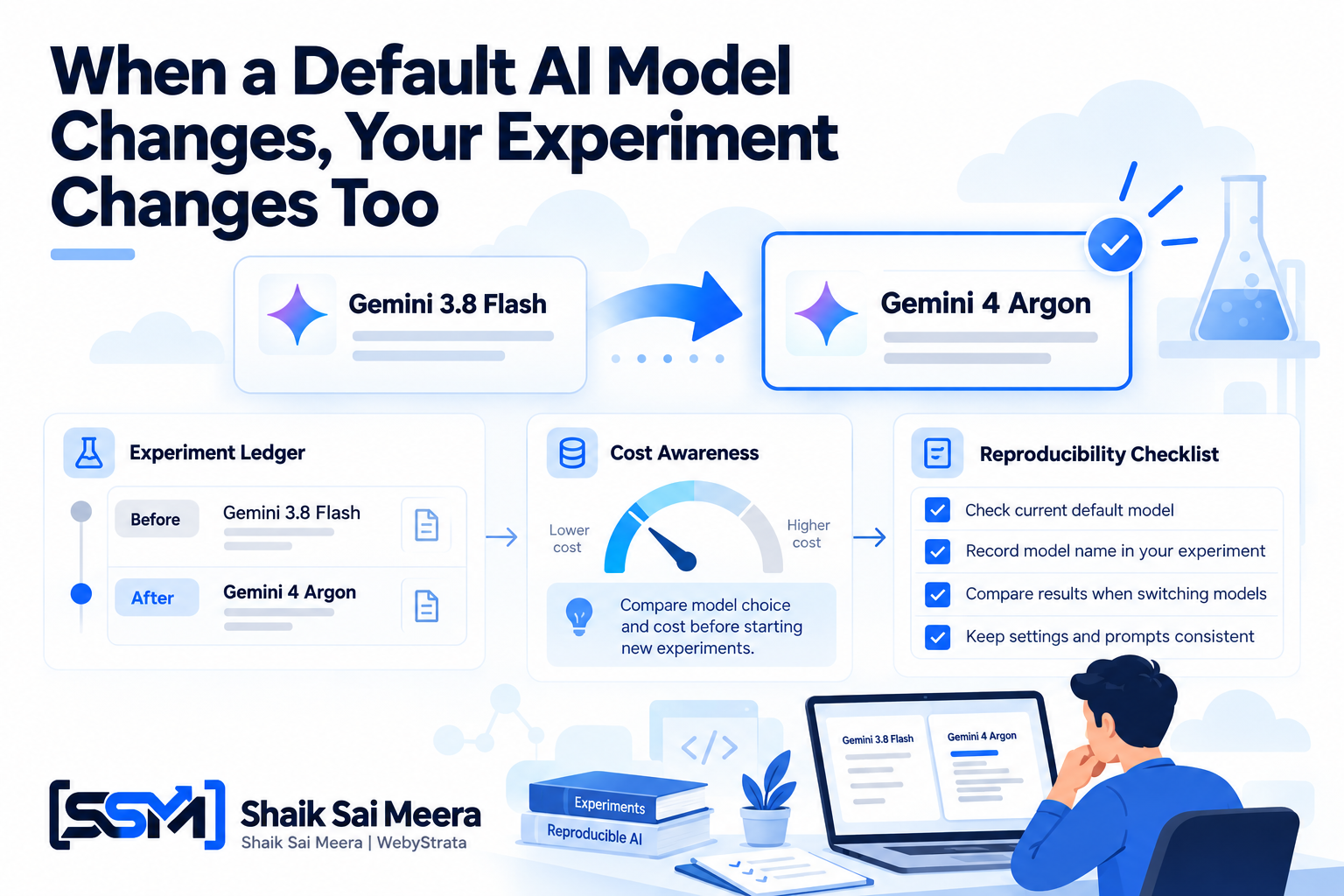
A model default can look like a small platform detail. In an experiment, it can quietly change the result, the bill, and the meaning of every comparison that follows.
In a release note dated October 26, 2026, Google Cloud says Gemini 4 Argon will replace Gemini 3.8 Flash as the default model for new AlphaEvolve experiments. The change applies when a new experiment does not specify a model in its models field. Experiments created before October 26 keep the model recorded in their configuration.
That distinction is important. This is not simply a new model appearing in a model catalogue. It changes what an otherwise unchanged experiment will use when its configuration relies on the platform default.
The hidden dependency in an unchanged experiment
Imagine a team has a small evaluation script that creates an AlphaEvolve experiment, supplies the prompt and generation settings, but leaves the models field unspecified. The script may be identical tomorrow, yet the model selected for a new run will be different from the model selected today.
That can make a result look like an improvement in the prompt, search strategy, or experiment design when the underlying model changed. It can also make a later run harder to compare with an earlier run because the same configuration no longer means the same model.
Google Cloud’s note does not claim that one model is universally better for every AlphaEvolve task. It states the platform change, the affected default, the billing implication, and how to keep using the previous model. That is enough to establish the operational lesson: a default is part of an experiment’s effective configuration, even when it is not written in the project file.
What changes on October 26
There are four practical details in the official announcement:
- New experiments: If the
modelsfield is omitted, new experiments use Gemini 4 Argon as the default. - Existing experiments: Experiments created before October 26 keep the model already recorded in their configuration.
- Billing: New experiments that use the default are billed at Gemini 4 Argon token prices instead of Gemini 3.8 Flash token prices.
- Explicit choice: Teams that want to continue using Gemini 3.8 Flash can specify
gemini-3.8-flashin themodelsfield.
The billing point deserves attention. A model change can affect both the behaviour of an experiment and its cost profile. A team that tracks only total spend may notice a change without immediately knowing that model selection was the reason. A team that tracks only output quality may miss a cost change until the experiment is used at a larger scale.
Why reproducibility needs more than prompts
Reproducibility is often discussed as if saving the prompt is enough. For model-driven experiments, the prompt is only one part of the record. The selected model, model version or alias, generation settings, tools, input data, and relevant platform defaults all shape the run.
The safest way to interpret this update is not to freeze every experiment forever. It is to make the choice visible. If a result matters, record the model name alongside the prompt and other settings. If a team intentionally wants to test the new default, label that run as a new model condition rather than silently mixing it with older results.
A simple experiment log might include:
- the date and time of the run in India Standard Time;
- the exact model value or the fact that the platform default was used;
- the prompt, tools, input data, and generation settings;
- token usage and observed cost;
- the evaluation criteria used to compare outputs.
A practical before-and-after workflow
Before creating a new experiment
Check whether the code explicitly sets models. If it does not, decide whether that is intentional. Read the current platform note, confirm the model that will be used, and estimate how the new price tier fits the experiment’s budget.
When comparing with an earlier run
Separate the model change from other changes. Run a controlled comparison where the old model is explicitly selected for one condition and the new model is explicitly selected for the other, while keeping prompts and evaluation rules as consistent as practical. This does not make the results identical to production behaviour, but it makes the reason for a difference easier to inspect.
When keeping the old model
Use the explicit model value named in Google Cloud’s note rather than relying on an old default. That makes the intent visible to future readers of the code and protects later runs from another default change. It also lets the team decide when to test a newer model instead of discovering the change indirectly through a result or bill.
The trade-off: convenience versus control
Defaults are convenient. They reduce setup work and allow a platform to move users toward newer capabilities. But convenience is not the same as experimental control. A default is appropriate for exploratory work where the newest platform choice is acceptable. It is less suitable for a benchmark, a cost estimate, a regression test, or a workflow whose results need to be explained months later.
There is also a maintenance cost to explicit pinning: the team must review the chosen model over time and decide when to update it. That is a real trade-off, not a reason to avoid pinning. The right choice depends on whether the priority is automatic platform evolution or stable, comparable runs.
What this means for small teams
A small team does not need a large governance process. One short checklist can prevent the most confusing outcomes:
- Read the latest release note before starting a new experiment.
- Write the model choice explicitly when results or costs matter.
- Record the model and token cost with each meaningful run.
- Compare old and new models as separate test conditions.
- Review code that silently depends on platform defaults.
The broader lesson extends beyond AlphaEvolve. Any platform that changes a default model, runtime, region, image, or storage behaviour can change the outcome of code that appears unchanged. The more important the result, the more valuable it is to turn hidden defaults into visible configuration.
Final takeaway
Google Cloud’s AlphaEvolve update is a useful reminder that reproducibility begins before the prompt runs. When a default model changes, an experiment’s behaviour and cost can change with it. Check the default, record the model, compare intentionally, and pin the choice when stable results matter.
Editorial note: This article is a general information summary based on the cited public sources. It is not legal, cybersecurity, or compliance advice.
Related Articles