Tech Insights
Why Portable PyTorch Matters More Than Picking an AI Chip
AWS’s latest Trainium update is interesting for a reason beyond one accelerator: native PyTorch support can make hardware experiments less expensive to reverse.
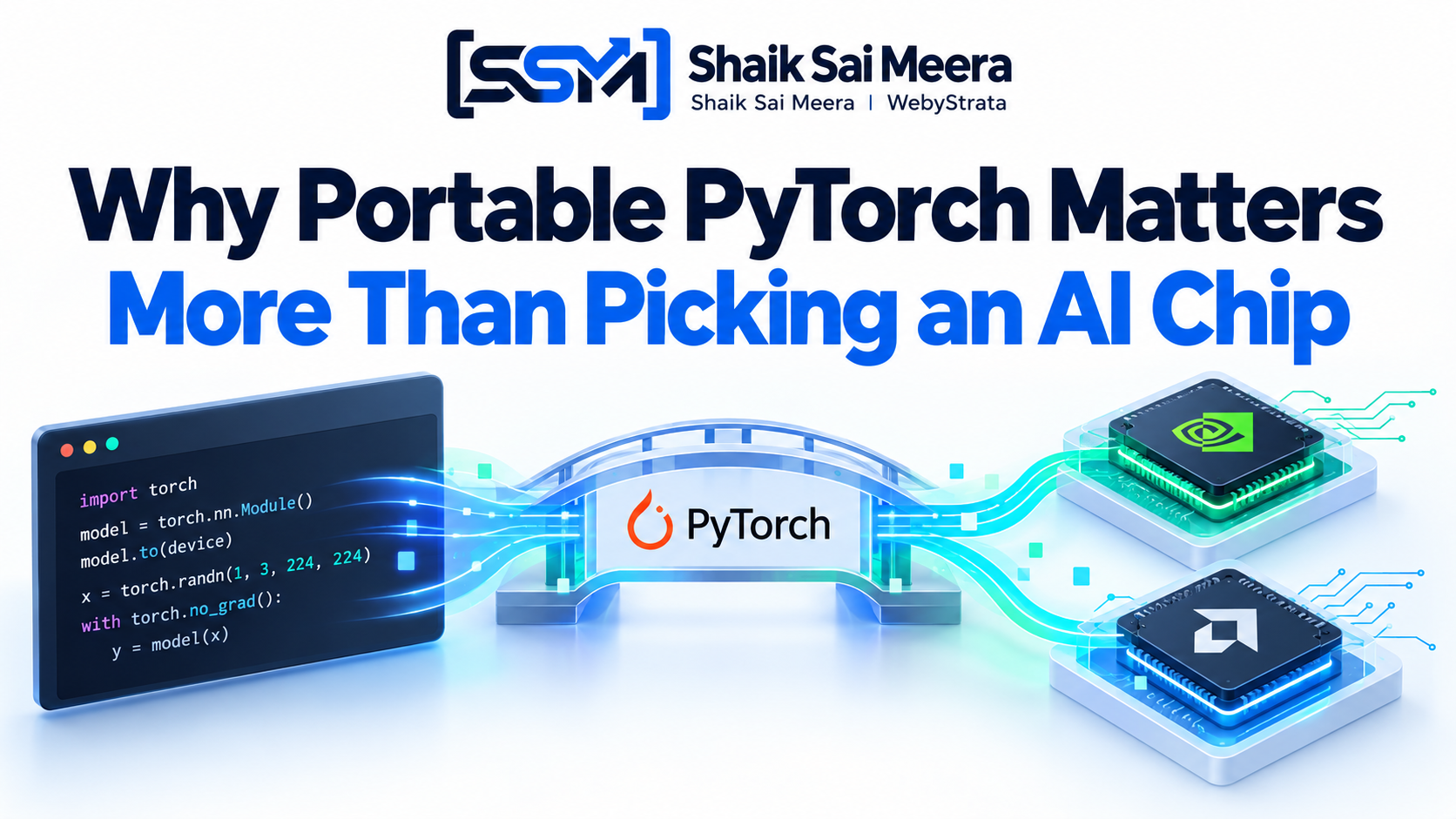
Choosing an AI accelerator is often presented as a hardware decision: compare speed, memory, availability and cost, then commit. In practice, the bigger decision may be hidden in the software. If moving to a new chip means rewriting models, changing training code and rebuilding the debugging workflow, a team is not only choosing hardware. It is choosing how difficult the next change will be.
That is the useful angle behind AWS’s October 26, 2026 weekly roundup, which highlights TorchNeuron, an open-source native PyTorch backend for AWS Trainium. AWS says the public beta lets developers run PyTorch code on Trainium by switching the device to .to('neuron'), while retaining eager execution, torch.compile and standard PyTorch APIs.
The announcement does not make Trainium a universal winner, and it does not remove every compatibility or performance question. The more important shift is that it lowers the cost of asking those questions. A team can test another hardware path without first turning its model stack inside out.
The old hardware tax was mostly engineering time
AI infrastructure discussions often focus on the price or performance of the accelerator itself. Those numbers matter, but they are only part of the bill. Teams also pay for the engineering work needed to make a model run on a different backend.
That work can include replacing device-specific code, adapting kernels, checking numerical differences, rebuilding distributed training jobs, changing profiling tools and updating deployment images. Even when the model architecture is portable in theory, the surrounding system may depend on assumptions made for one hardware family.
A practical example is a small research team that has a working PyTorch training pipeline and wants to test a different cloud accelerator. If the first experiment requires a large rewrite, the team may postpone it—not because the alternative is uninteresting, but because the experiment is too expensive to begin. Portability changes that decision from “migrate everything” to “run a controlled comparison.”
What TorchNeuron changes
AWS describes TorchNeuron as an open-source native PyTorch backend for Trainium2 and Trainium3 instances. The stated workflow is familiar to PyTorch developers: use standard APIs, select the Neuron device, and continue working with eager execution or torch.compile.
AWS also says the backend integrates with the Neuron Kernel Interface (NKI), which lets teams build custom operators and tune workloads more deeply when standard operations are not enough. That creates a two-level path: begin with familiar PyTorch code, then add hardware-specific optimisation only where it provides value.
That sequence is important. Developers can first measure the unmodified or lightly modified workload, then decide whether custom kernels are justified. Hardware-specific work becomes an optimisation choice rather than the entry fee for trying the platform.
Why open source matters here
The word “open source” is not a guarantee of portability by itself. A project can be open while still depending heavily on one provider’s chips, images or runtime. But open code can make the integration easier to inspect, test and improve.
AWS’s related explanation says TorchNeuron is released under the Apache 2.0 license and that changes were contributed to PyTorch. AWS also says the same model checkpoints can load on other supported hardware. Those claims are meaningful because they place portability in more than one layer: the backend is visible, the framework integration is shared, and model artifacts are not described as being trapped in one format.
The practical benefit for a team is optionality. It can evaluate an accelerator without assuming that every future training or inference decision will use the same one. Optionality has value when hardware supply, regional availability, workload shape or cloud pricing changes.
What this does not solve
Portability reduces friction; it does not erase trade-offs. A model may run successfully on a new backend and still require performance tuning. Memory behaviour, communication patterns, kernel availability, compilation time and distributed scaling can all differ by workload.
There is also a difference between “the code runs” and “the code is production-ready.” Teams need to compare accuracy, throughput, latency, utilisation, operational tooling and total cost for their own models. A convenient device switch is useful for the first experiment, but it is not a benchmark result.
Public beta status matters too. Early users should expect documentation, integrations and performance characteristics to continue evolving. A team planning a production migration needs a clear rollback path and should preserve the ability to run the original pipeline while it evaluates the new backend.
A better way to evaluate new AI hardware
The most useful test is not a vendor demo. It is a small, repeatable workload from the team’s own codebase.
Start with one model, one dataset slice and one measurable objective. Record the baseline on the current hardware. Then run the same workload on the alternative path with as few code changes as possible. Compare more than tokens per second: include setup time, compilation behaviour, memory use, failure modes, debugging effort and the cost of returning to the original environment.
After that baseline, profile the slowest part. If a custom operator or NKI kernel can improve the result, the team can make that targeted investment with evidence. If the baseline is already competitive, it may not need a deeper rewrite.
The larger infrastructure lesson
AI hardware competition is often described as a race between chips. For developers, the more durable contest may be between ecosystems that make experimentation easy or difficult.
A backend that meets developers where they already work can change the economics of trying something new. It gives teams a way to learn before they commit, and it makes future hardware changes less disruptive. That can be especially valuable for smaller companies that cannot afford a large platform team for every infrastructure experiment.
The takeaway
TorchNeuron’s most interesting promise is not that one AI chip will replace another. It is that the software path between them can become shorter. If a familiar PyTorch workload can be moved, measured and tuned without a full rewrite, hardware selection becomes a reversible experiment rather than a once-and-for-all bet.
The teams that benefit most will not be the ones that choose a chip from a feature sheet. They will be the ones that keep their model code portable enough to test the next option before the current option becomes a constraint.
Editorial note: This article is a general information summary based on the cited public sources. It is not legal, cybersecurity, or compliance advice.
Related Articles