Tech Insights
AWS Systems Manager Runbooks Can Now Reach Azure and Google Cloud: What Platform Teams Should Guard First
AWS Systems Manager Automation has gained a practical multicloud capability: runbooks can now target Microsoft Azure and Google Cloud resources through a Systems Manager Cloud Connector. The change is listed in AWS’s official release…
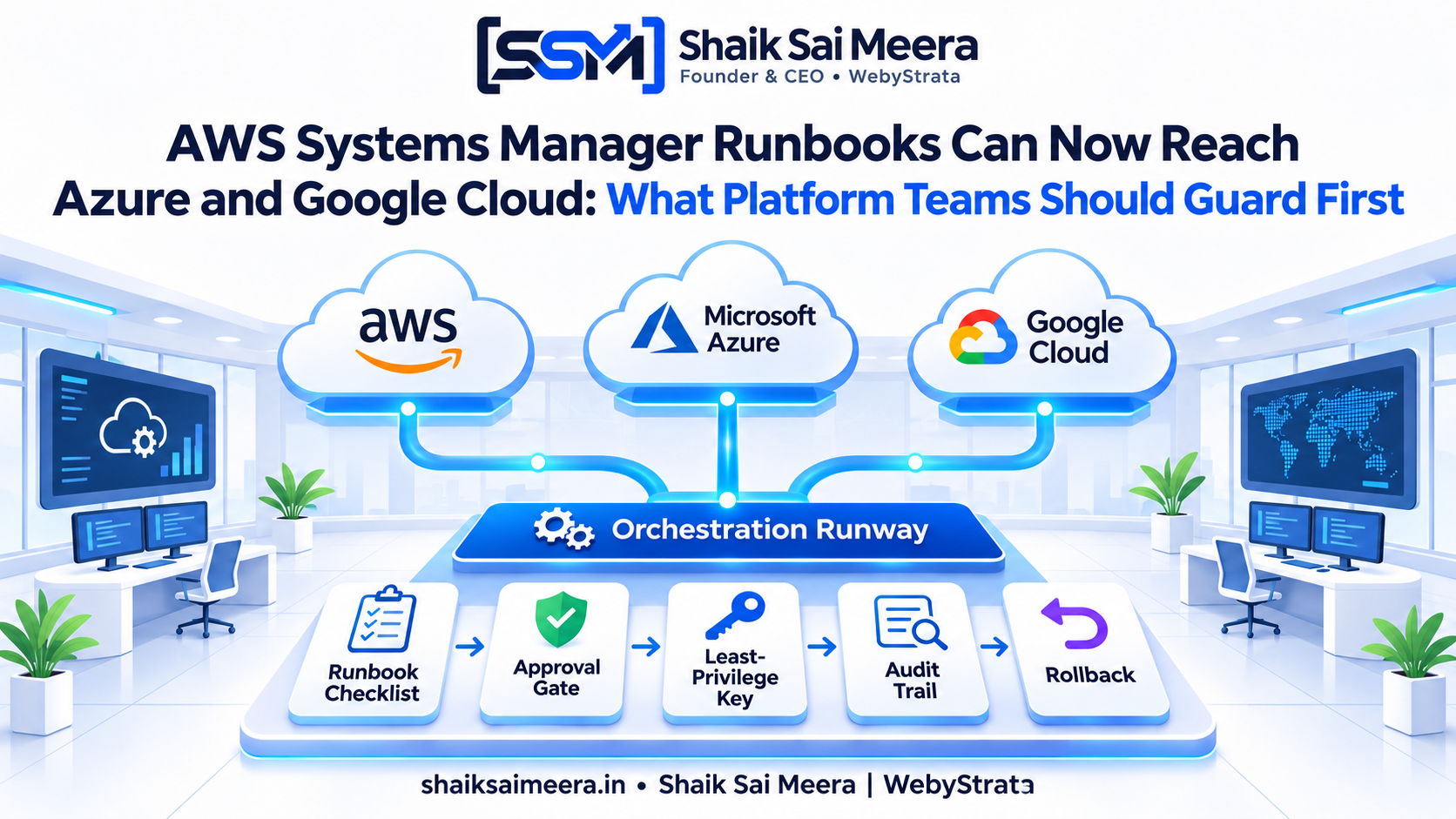
AWS Systems Manager Automation has gained a practical multicloud capability: runbooks can now target Microsoft Azure and Google Cloud resources through a Systems Manager Cloud Connector. The change is listed in AWS’s official release history for 24 November 2026, so platform teams reviewing it in India on 24 November IST should treat it as a current operational update rather than a roadmap promise.
The new entries say administrators can specify the cloud providers an Automation document version may run against, call Microsoft Azure and Google Cloud APIs from runbooks, and run Automation runbooks on resources in those clouds. The announcement is easy to underestimate because it appears in documentation rather than a large product launch. For teams that already use Systems Manager as an operational control plane, however, it changes where a runbook can act—and therefore where permissions, approvals, logging, and failure handling need to be designed.
AWS’s Systems Manager release history is the primary reference for the dated changes. Availability, supported resources, and regional behavior should still be checked in the specific Cloud Connector and Automation documentation before a production rollout.
What the update actually adds
There are three related changes. First, a runbook can use an optional CloudProviders parameter to specify AWS, Azure, or Google Cloud. That creates an explicit target boundary instead of leaving provider selection implicit in the script or operator’s assumptions.
Second, an Automation runbook can call Azure and Google Cloud APIs through the Cloud Connector, either through new API actions or through a cloud SDK inside aws:executeScript. This means a runbook can combine AWS-native steps with provider-specific operations in one controlled workflow.
Third, a runbook can operate on Azure and Google Cloud resources through the connector. The useful distinction is that this is not simply a dashboard link or a report integration. It is an operational path. A runbook might inspect an Azure VM, change a Google Cloud setting, or coordinate a recovery sequence alongside AWS actions—subject to the connector’s supported operations and the identities granted to it.
That last qualification matters. “One runbook” does not mean “one universal permission.” The workflow still crosses separate clouds with separate identity systems, resource models, audit trails, quotas, and outage modes.
A practical example: a cross-cloud maintenance window
Imagine a company that runs its public API on AWS, its analytics worker on Azure, and a disaster-recovery copy of its data pipeline on Google Cloud. During a planned maintenance window, the platform team wants to place all three environments into a known state before applying a database change.
A multicloud runbook could begin by checking that the AWS deployment is in the expected release, then call Azure to pause a worker pool, and finally call Google Cloud to confirm that the recovery pipeline is stopped and its last checkpoint is recent. The runbook can require an approval before the destructive or irreversible step. After the change, it can resume the worker pools and validate service health across all three environments.
The value is not that the workflow becomes magically simple. The value is that the sequence, inputs, approvals, and evidence can live in one repeatable operational path. A human can see which step failed, which provider was involved, and whether the rollback branch ran. That is usually easier to govern than a collection of unrelated shell scripts, console checklists, and tribal knowledge.
What platform teams should design before using it
Start with identity separation. Give the connector only the provider actions required for the runbook, and use different roles for read-only discovery, reversible changes, and high-impact operations. Avoid a single cross-cloud credential that can administer every environment. If a runbook only needs to confirm VM state, it should not be able to delete or reconfigure the VM.
Next, make the provider explicit in the runbook input. A parameter such as CloudProviders=Azure is more than documentation; it is a guardrail against running a step against the wrong connector or assuming that an AWS resource identifier means the same thing elsewhere. Validate account, subscription, project, region, and environment labels before the workflow changes anything.
Then build a dry-run path. The first version of a runbook should gather state and produce a reviewable plan. For example, it can list the resources it would pause, show the identity it would use, and record the intended changes without applying them. This gives teams a chance to catch naming collisions and incomplete provider mappings before an outage turns the first test into an incident.
Finally, define failure semantics. A cross-cloud workflow can fail halfway through because one provider is unavailable, a token expires, an API rate limit is reached, or a resource has drifted. The runbook needs explicit checkpoints and compensating actions. “Rollback” may not mean restoring the exact previous state; in some cases it means safely re-enabling traffic, preserving logs, and opening a human intervention step.
Trade-offs: centralization versus cloud independence
Centralizing orchestration in Systems Manager can reduce duplicated tooling and make approvals easier to audit. Teams already using AWS Automation may also get a shorter path to multicloud operations than adopting a separate orchestration platform.
The trade-off is additional dependence on the connector and on AWS as the workflow control plane. If the runbook cannot reach Systems Manager, the connector, or the required provider API, the workflow may stop even when the target cloud is healthy. Keep an emergency path for provider-native recovery, and document how operators can act when the central orchestrator is unavailable.
There is also a portability cost. A runbook that deeply encodes AWS actions, Azure resource types, and Google Cloud API behavior may be efficient for one organization but difficult to move. Keep provider-specific steps behind clear inputs and small modules so the workflow remains understandable and testable.
A safe adoption sequence
Use the feature first for read-only inventory, compliance evidence, and maintenance prechecks. Measure execution time, API failures, permission denials, and the quality of the generated audit record. Next, introduce reversible changes such as pausing a worker or toggling a maintenance flag. Only after those paths are reliable should the team automate data movement, failover, or destructive cleanup.
The broader lesson is that multicloud automation is moving from “run a script everywhere” to “declare a controlled operation across distinct trust domains.” AWS’s new Systems Manager entries make that pattern more accessible for existing users, but the hard work remains operational: least privilege, clear provider boundaries, approvals, rollback design, and an emergency path that does not depend on the same control plane being healthy.
This article is a general information summary based on the cited public sources. It is not legal, cybersecurity, or compliance advice.
Related Articles