Tech Insights
Baidu Opens ERNIE 5.5 Flash Preview Weights: What 1M-Token AI Teams Should Test First
Baidu has released ERNIE 5.5 Flash Preview, an open-weight mixture-of-experts model aimed at long-context coding, knowledge work, 3D design, and content creation. The release is timely for teams that want to evaluate a large…
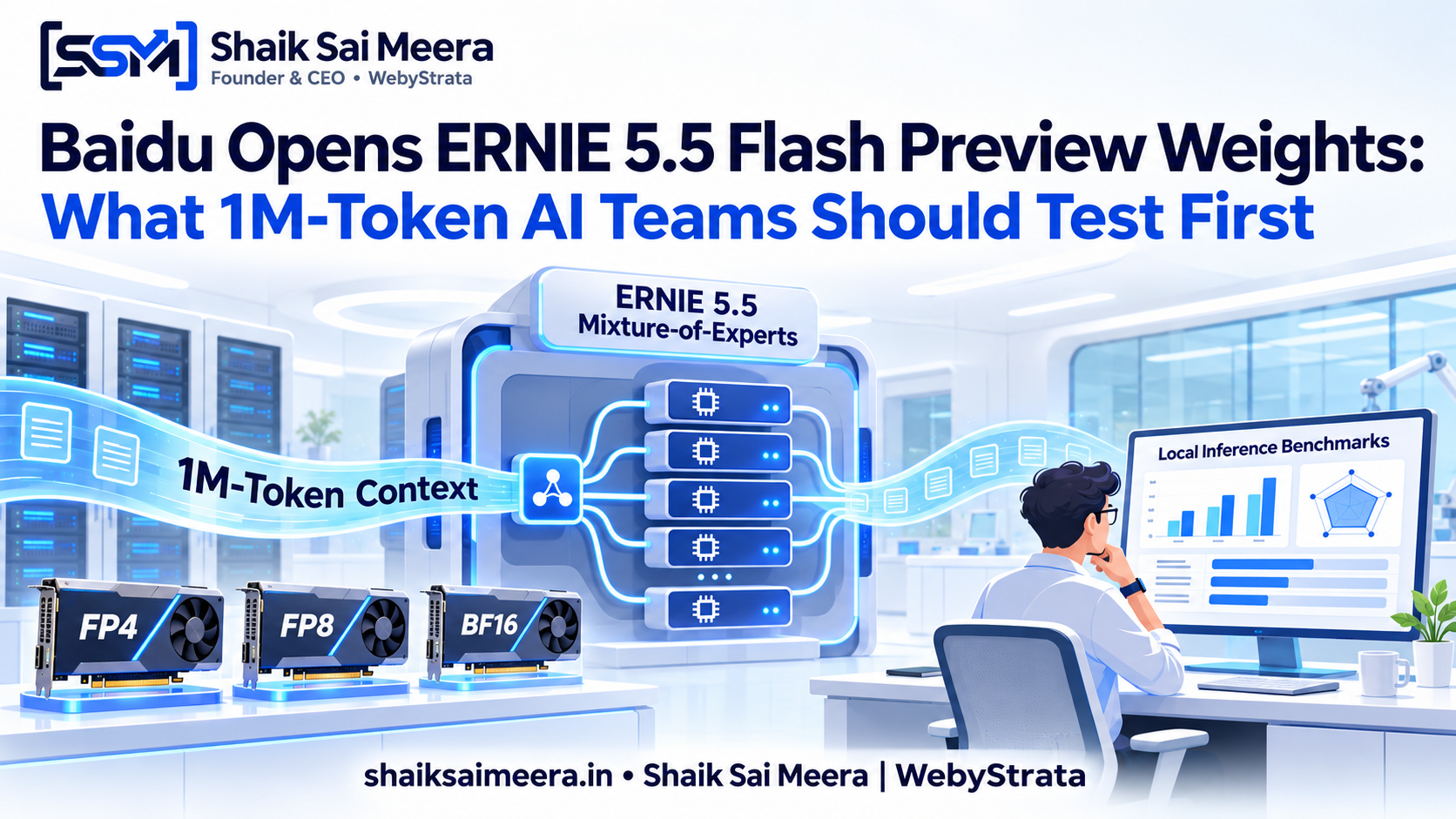
Baidu has released ERNIE 5.5 Flash Preview, an open-weight mixture-of-experts model aimed at long-context coding, knowledge work, 3D design, and content creation. The release is timely for teams that want to evaluate a large model in infrastructure they control rather than sending every prompt to a hosted endpoint. Baidu’s announcement is dated 24 November 2026, so Indian engineering teams reviewing it on 24 November IST can treat the weights as a current release, not an upcoming promise.
The model has 280 billion total parameters, 14 billion active per token, and a context window of up to 1,048,576 tokens. Baidu says the preview is available through its Qianfan platform and that the weights are being released under Apache 2.0. The official ERNIE release page describes the model’s intended workloads, while the Baidu model card on Hugging Face provides deployment options, precision variants, and benchmark details.
Why this release matters beyond the parameter count
The headline number is 280B, but the operational story is the 14B active-parameter path. ERNIE 5.5 Flash Preview is a mixture-of-experts model: each token is routed through a subset of the available experts rather than activating the entire network. That can improve serving efficiency, although it does not make the model small. Teams still need substantial accelerator memory, a suitable parallelism strategy, and a serving stack that understands the model’s architecture.
The model card also describes FP4 routed experts, FP8 key-value cache support, and a DSpark speculative-decoding head. In plain language, the release is designed around the cost of generating tokens, not only the quality of the final answer. Speculative decoding lets a draft component propose several tokens while the main model verifies them, potentially reducing the time spent on sequential generation.
These are engineering claims to test, not universal performance guarantees. Throughput will depend on GPU type, tensor and data parallelism, prompt length, concurrency, context length, quantization, and the serving version. A model that is fast for one short coding prompt may be expensive when many users submit million-token documents at the same time.
What teams can actually run
Baidu provides FP4, FP8, and BF16 repositories. The default repository uses blockwise FP8 with FP4 routed experts and the DSpark head. The FP8 variant is a more conservative option for hardware without the required FP4 kernels, while BF16 is the recommended starting point for fine-tuning. The model card lists vLLM and SGLang deployment paths and exposes an OpenAI-compatible request shape after the server is running.
That compatibility is useful, but it should not be mistaken for complete drop-in equivalence. Tool calling, reasoning output, tokenizer behavior, context limits, streaming, and error handling can vary between model families and server versions. Put the model behind an internal gateway and normalize the interface there. Keep provider-specific parameters out of application code where possible.
A practical first test for a local AI team
Suppose a software company wants to use a long-context model to review a large monorepo and its architecture documents. Instead of starting with a production migration, the team can create a three-part evaluation.
First, measure retrieval and comprehension. Provide a controlled set of documents containing repeated names, deliberately conflicting requirements, and one small but important exception near the end. Ask the model to produce a change plan and cite the exact files or sections it used. Score whether it found the exception, preserved constraints, and clearly separated evidence from inference.
Second, measure coding behavior. Give it a reproducible bug, a test suite, and a sandboxed repository. Require it to explain the proposed change, run tests, and stop when the test environment is unavailable. Record success rate, tool-call errors, tokens, latency, and the number of human corrections. A long context is valuable only if the model can keep the relevant parts in working focus.
Third, measure serving economics. Run the same tasks at short, medium, and long context lengths under one, four, and eight concurrent requests. Track time to first token, tokens per second, peak memory, queue time, and failure rate. Include warm-up time and model loading in the operational picture. If the team cannot explain the cost of a 500,000-token request, it is not ready to offer a million-token context to every user.
Trade-offs of open weights
Open weights can improve control over data locality, retention, network routing, and deployment timing. They also allow a team to inspect the model package, tune serving, and build an evaluation process without waiting for a hosted provider to expose every configuration. Apache 2.0 for the preview weights is a permissive license for many software uses.
Control comes with responsibility. The license for the weights is not the same thing as a promise that every dataset, output, or downstream use is risk-free. Teams still need to review acceptable-use requirements, data protection obligations, provenance, model-card limitations, and the licenses of supporting code or quantizations. They should also plan for security updates: a downloaded model is another software artifact that must be pinned, scanned, stored, and promoted through environments.
The preview label is important too. Baidu says post-training is ongoing and that some capabilities may fall short while the model improves. Benchmark tables in the model card are largely Baidu’s own evaluations, and comparisons can depend on harnesses, prompts, and reasoning settings. Reproduce the tasks that matter to your organization before making a broad quality claim.
What to test before adoption
Start with a small, isolated deployment and an evaluation set that includes the languages, documents, code styles, and failure modes your users actually have. Test multilingual prompts if your business needs them. Test prompt injection inside long documents. Test whether sensitive content is logged by the serving layer. Test model restarts, GPU loss, backpressure, and requests that exceed the configured context.
For most teams, the right first use is an internal benchmark or a narrow assistant with human review. Do not place the preview directly in a customer-facing workflow merely because it has a large context window. The valuable question is not whether ERNIE 5.5 Flash Preview can process a million tokens. It is whether your team can operate that capability predictably, affordably, and safely.
This article is a general information summary based on the cited public sources. It is not legal, cybersecurity, or compliance advice.
Related Articles