Tech Insights
AWS Transform Adds Line-Level Traceability to Mainframe Modernization
AWS Transform now maps mainframe business functions and requirements back to specific source lines, giving modernization teams a clearer coverage trail before forward engineering.
Mainframe modernization often stalls before the code is changed. Teams first need to understand which business functions exist, how data moves through them and whether a proposed target system preserves the rules that matter. That discovery work is difficult when the evidence is spread across COBOL or PL/I source, JCL, screens, data files and years of institutional knowledge.
AWS is adding a more detailed traceability layer to that process. In a November 3, 2026 announcement, AWS said AWS Transform for mainframe can now discover business functions with field-level precision and produce a requirements coverage report in its assess and reimagine workflow.
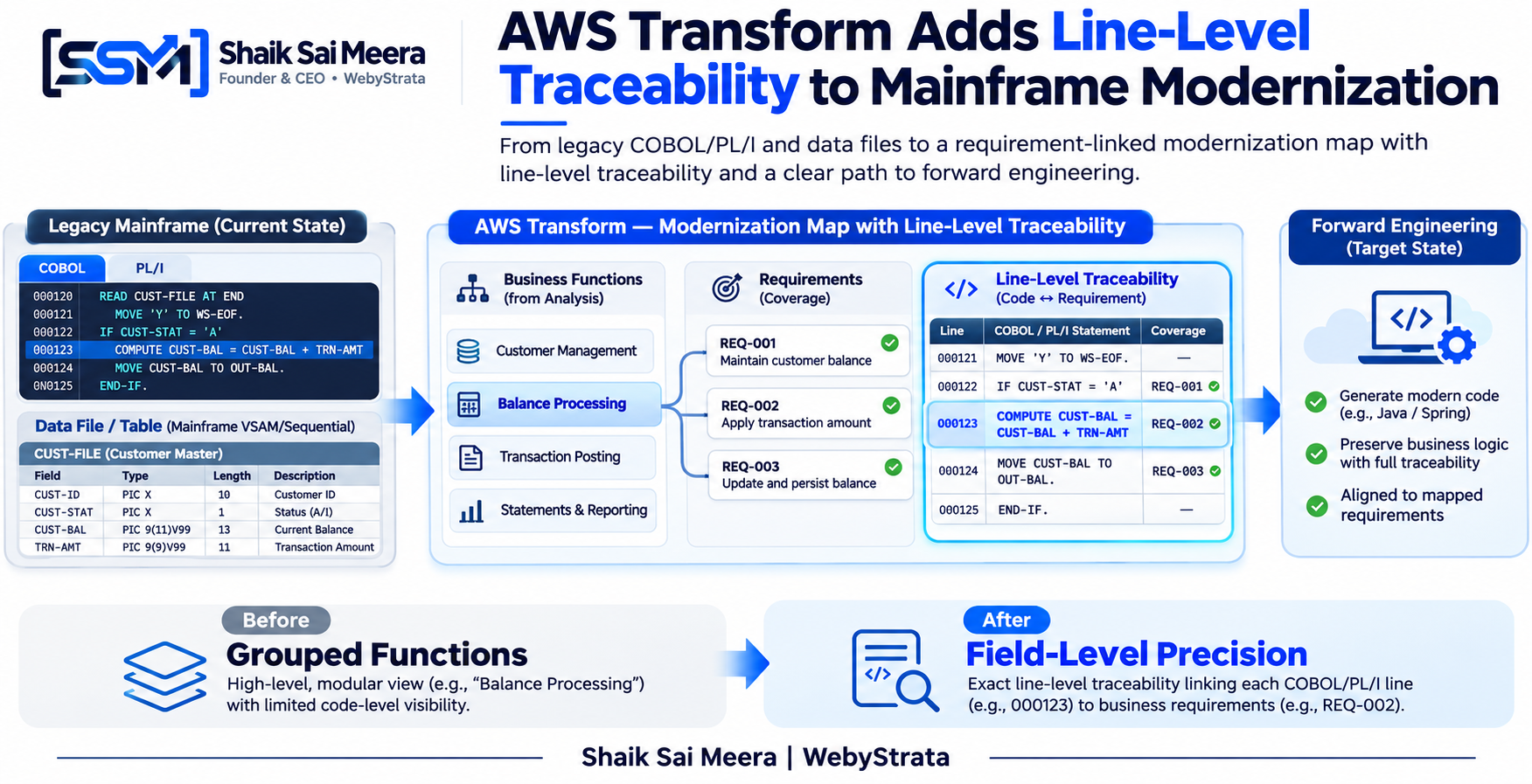
The practical change is from a high-level catalog to a more inspectable chain: business function, business rule, requirement and the source-code lines that support it. For teams deciding what to modernize, that can make a review less dependent on grouped labels and more grounded in the actual application logic.
Why grouped business functions were not enough
A modernization catalog needs useful boundaries. If a tool groups every function that touches the same table or file into one large unit, the result can be too coarse for planning. Two workflows may use the same data store while applying different business rules, serving different screens or writing different outputs.
AWS says the earlier workflow grouped business functions when they used the same table or file. The new behavior groups them only when they affect the same data fields, and the functions now include screens and queues with clearer names and descriptions.
That distinction matters during a portfolio review. A team may want to modernize balance calculation before statement generation, or migrate a transaction path while leaving a reporting function in place. Field-level precision gives the team more evidence for deciding whether those are separate modernization candidates.
The coverage report closes the review gap
The second part of the announcement is the requirements coverage report. AWS says it shows how every part of the application is accounted for in the generated requirements. Each line of source code is classified by how it was handled, each business rule links to the exact lines it came from, and each requirement is backed by the business rules that support it.
That creates a coverage chain that can be reviewed before a modern implementation is built:
- The original source expresses a calculation, condition, data update or user interaction.
- A business rule describes the behavior in a form that stakeholders can discuss.
- A requirement turns that behavior into a testable modernization target.
- The coverage report shows whether the source material is represented in the generated requirements.
This does not prove that the new application is correct. It gives the review team a more direct way to find what is missing or ambiguous before forward engineering. That is a valuable difference because omissions discovered after code generation are usually more expensive to explain and repair.
A concrete modernization example
Imagine a COBOL account-processing program that reads a customer file, checks a status field, calculates a balance adjustment and writes a transaction record. The same program may also update a screen and place a message on a queue.
A coarse analysis might label the entire flow “account processing.” A field-aware analysis can separate the business behavior around customer status, balance calculation, transaction posting and message delivery. The requirements report can then connect each requirement to the rules that support it and to the source lines that implement those rules.
For a modernization team, that makes a review conversation more concrete. Instead of asking whether “account processing” was preserved, reviewers can ask whether the rule that blocks inactive accounts, the calculation that adjusts the balance and the queue message that triggers a downstream workflow all have corresponding requirements and tests.
What changes before forward engineering
AWS says the new coverage information can be reviewed from the full portfolio down to a single line before teams build. That changes the order of work. A team can inspect the boundaries and requirements first, identify gaps, and only then start generating or adapting modern code.
The benefit is not simply better documentation. It is better sequencing. Modernization work can be split into smaller waves when functions have clearer data and behavior boundaries. Requirements can be assigned to reviewers who understand the business process. Test cases can be tied to rules rather than only to screens or program names.
AWS Transform’s mainframe workflow documentation describes the broader journey: assess the codebase, identify business functions, extract business logic and generate requirements that become inputs for forward engineering. The new traceability layer fits into that workflow as a way to inspect the connections between those artifacts.
Traceability is useful only if the inputs are complete
There is an important limit to what a report can show. AWS Transform analyzes the assets provided to it. The AWS Transform documentation lists supported mainframe inputs such as COBOL, PL/I, JCL, CICS transactions, BMS screens, Db2 and VSAM data files.
If a dependency, copybook, data definition or runtime convention is missing, the traceability chain may be incomplete because the underlying evidence is incomplete. A line-level link can be precise and still fail to capture behavior that lives outside the uploaded source or depends on an external operational process.
This is why the new feature should be treated as a review aid rather than an automatic sign-off. The report can make the evidence easier to navigate; it cannot replace the people who know which batch schedules, data conventions and exceptional cases matter to the business.
The report also changes how teams measure progress
Modernization programs often report progress through the number of programs analyzed or functions selected. Those numbers can hide unresolved uncertainty. A coverage report creates another set of questions:
- How much source code maps to a documented business rule?
- Which requirements have no supporting rule or source lines?
- Which business functions share fields but have different outcomes?
- Which requirements still need human clarification before code is generated?
These measures do not guarantee a successful migration, but they make unknowns visible earlier. A team can choose to pause a modernization wave because requirements are incomplete instead of discovering the gap after the target application has been produced.
What teams should review in a pilot
A focused pilot can use one business function with a known set of inputs and outcomes. Review whether the tool identifies the expected fields, separates adjacent functions, links rules to requirements and classifies source lines in a way that engineers can understand.
Then compare the generated requirements with existing documentation and a small set of known test cases. Look for missing exceptional paths, external dependencies and rules that were historically understood but never written down. The value of the new report is highest when it helps a reviewer find those gaps before the target implementation is built.
AWS Transform’s update makes mainframe modernization more inspectable. Field-level business functions and line-linked coverage do not remove the complexity of COBOL, PL/I, data stores or institutional knowledge. They give teams a sharper map of how the existing system becomes a modernization plan—and a better chance to ask the hard questions before forward engineering begins.
This article is a general information summary based on the cited public sources. It is not legal, cybersecurity, or compliance advice.
Related Articles