Tech Insights
GitHub’s New Cost-Center API Turns Enterprise Billing Into an Automation Problem
GitHub has added a REST endpoint that identifies the cost center for a user, organization, repository or enterprise team, opening a more direct path to chargeback and billing automation.
Enterprise billing systems are full of small questions that become expensive when they must be answered repeatedly: Which team owns this repository? Which organization is paying for this user? Is this resource assigned to a cost center at all?
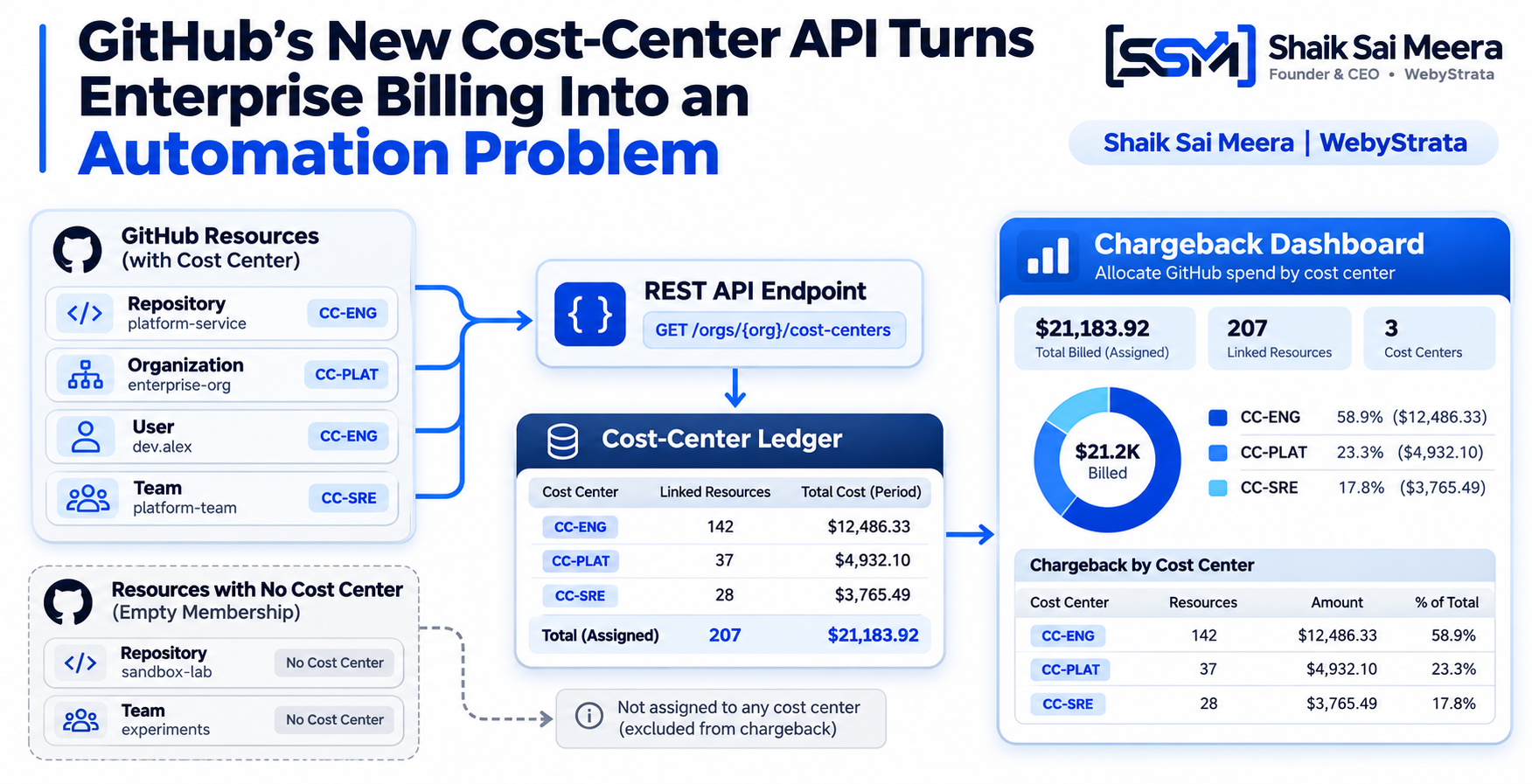
GitHub’s answer is a new REST API lookup. In a November 3, 2026 changelog update, GitHub introduced an endpoint that finds the cost center membership of a user, organization, repository or enterprise team. The response returns the cost center’s ID and name, or an empty memberships array when the resource is not assigned.
That sounds like a narrow billing feature. Its larger value is operational: teams can now ask GitHub directly about one resource instead of listing every cost center and scanning all of their resources. For finance, platform and engineering operations, that turns a manual reconciliation step into an API call that can sit inside an inventory job, chargeback report or policy check.
Before and after the new endpoint
Before the change, a script that needed to answer “which cost center owns repository X?” had to retrieve the enterprise’s cost centers, inspect their associated resources and search for a match. That approach becomes more cumbersome as the number of cost centers and repositories grows. It also makes a single-resource lookup dependent on the completeness and freshness of a larger scan.
GitHub’s new endpoint accepts a resource type and name. The official cost-center API documentation lists the supported resource types as user, repository, organization and team. A repository is identified in the owner/repo form, while users, organizations and teams use their login or enterprise team slug.
The difference is a change in query shape. Instead of asking GitHub for every cost center and filtering locally, an internal tool can ask for the membership of the resource it is already processing. The result is easier to attach to an existing repository inventory or billing workflow.
A concrete chargeback example
Imagine a platform team that generates a weekly report for hundreds of repositories. The report already knows the repository name, organization, primary team and activity level. To add billing ownership, it can call the cost-center membership endpoint for each repository and append the returned cost-center ID and name.
The report can then separate three states:
- the repository is assigned to one or more cost centers;
- the repository is visible but has an empty
membershipsarray; or - the caller cannot access the resource or enterprise billing data.
That third state is important. “No cost center” and “could not verify cost center” are not the same result. A useful automation should preserve the difference so a missing assignment is not confused with a permission problem.
The same pattern works for onboarding. When a new repository is created, a platform workflow can check whether it belongs to a cost center and route unassigned resources to an owner. The API does not create the business rule; it supplies a direct fact that another system can use.
Why the response is useful for governance
Cost centers are not only finance labels. In a large GitHub enterprise, they can describe how teams group repositories, organizations and users for spending visibility. A direct membership lookup helps governance tools answer resource-level questions without building a second copy of the entire cost-center graph.
For example, a platform dashboard could show each repository with its cost-center name, owning team and last activity. A cleanup workflow could identify repositories that have no cost-center membership before they are archived or transferred. A finance export could compare the assigned resources with the organization’s internal cost-allocation records.
Those are use cases built around the API, not promises that GitHub’s endpoint automatically performs chargeback or enforces ownership. The quality of the result still depends on how consistently an enterprise assigns resources to cost centers and how its internal system interprets the response.
Access is part of the design
GitHub says enterprise owners, billing managers and GitHub Apps with read access to enterprise billing can look up any resource in the enterprise. Organization owners and custom-role users with the relevant read access are limited to resources and cost centers they can already see.
The documentation adds more detail. Enterprise owners and billing managers can use a classic personal access token or OAuth access token with the manage_billing:enterprise scope. Fine-grained personal access tokens cannot access the enterprise endpoints, and GitHub App authentication depends on whether the enterprise can grant the required permission.
That means an automation should not assume that one token can answer every query. A repository inventory that crosses organization boundaries may need to run with an enterprise-level identity. A team-level tool may intentionally see less. The API’s permission model is therefore part of the data model: a missing result may reflect access boundaries, not missing billing configuration.
What the endpoint does not solve
The new lookup makes membership easier to retrieve, but it does not remove several sources of ambiguity.
First, a resource may have no cost-center membership. The API returns an empty array, which is useful but not a cost allocation. The consuming system still needs a policy for unassigned resources.
Second, multiple memberships may need interpretation. A report should not silently assume that the first cost center in the response is the only owner. The correct treatment depends on the enterprise’s billing rules and the resource type.
Third, the endpoint does not replace historical reporting. If a repository moves between cost centers, a point-in-time lookup only shows the current state. A chargeback system that needs historical accuracy must record snapshots or consume a suitable event stream.
Finally, the API does not prove that the cost center assignment is semantically correct. It can tell an automation what GitHub currently records. It cannot tell whether the assignment still matches the team that owns the work.
A practical rollout pattern
- Start read-only. Add membership lookups to an inventory or reporting job before changing cost-center assignments.
- Classify responses. Keep “assigned,” “unassigned” and “not visible” as separate states.
- Cache carefully. Avoid needless repeated queries, but record when the membership was observed.
- Compare with internal ownership. Check GitHub’s result against the team directory, repository metadata or finance system.
- Automate only after review. If the data is consistent, use the endpoint to flag or route unassigned resources.
GitHub’s cost-center lookup is a small API addition with a useful architectural consequence. It gives enterprise tooling a direct way to connect a specific GitHub resource to billing ownership, reducing the need for broad scans and local matching. The feature will be most valuable to teams that treat billing data as part of platform operations, while remembering that permissions, empty memberships and historical state still require deliberate handling.
This article is a general information summary based on the cited public sources. It is not legal, cybersecurity, or compliance advice.
Related Articles