Tech Insights
GitHub’s Python 3.15 Update Gives Security Checks a Head Start
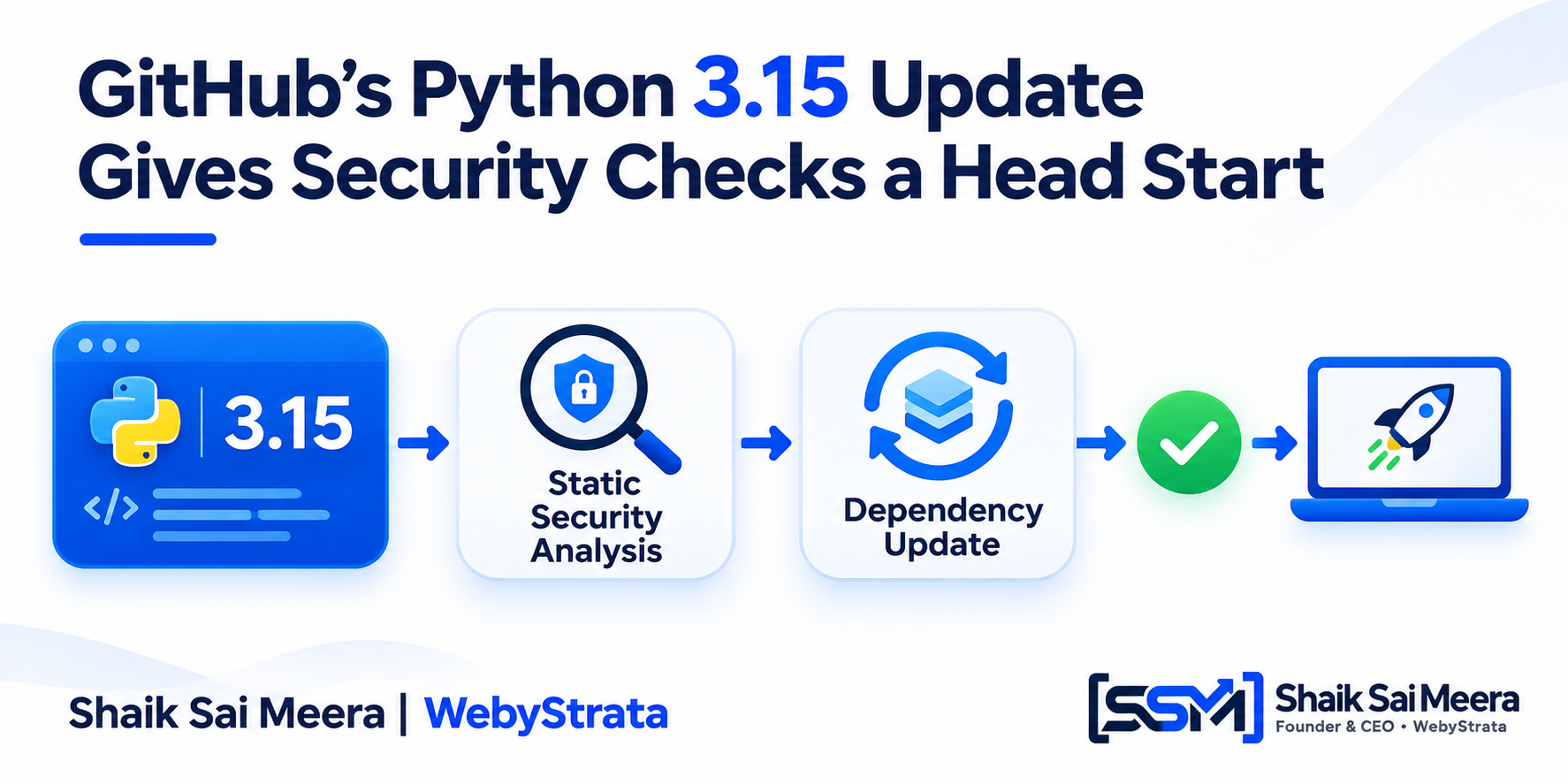
GitHub has added Python 3.15 support to CodeQL and Dependabot, making it easier to move a project to the new runtime without dropping static analysis or dependency updates.
A new language runtime can be exciting for developers and inconvenient for the security pipeline. The code may run correctly on a local machine while the analysis engine still misunderstands the syntax, or the dependency bot may not recognize the project’s new version and quietly stop producing useful updates.
GitHub addressed that gap on November 3, 2026, with two related improvements. Its CodeQL 2.27.3 update adds support for Python 3.15 language features and new JSON data extensions. In a separate Dependabot announcement, GitHub says projects can now upgrade to Python 3.15 while continuing to receive Dependabot updates.
The practical story is not that Python 3.15 is automatically safer. It is that two important parts of a development workflow now understand the new runtime. That gives teams a better starting point for testing the upgrade instead of choosing between new language support and familiar security coverage.
Why runtime support affects security work
Static analysis depends on more than a file ending in .py. A scanner needs to parse the language correctly, understand built-in types and follow data as it moves through an application. If the parser does not recognize new syntax, it may fail, skip code or produce results that need more manual review.
GitHub says CodeQL 2.27.3 supports new Python 3.15 syntax, including unary plus in match literal patterns and Unicode 17 identifiers. It also adds support for the new frozendict and sentinel built-ins, including data-flow modeling for frozendict construction.
Those details matter because the quality of a security finding depends on the analysis engine’s model of the program. A new feature that is syntactically valid but poorly modeled can create blind spots or false alarms. The update does not eliminate those possibilities, but it brings the engine closer to the code teams are actually writing.
Dependabot closes a different part of the gap
CodeQL examines source code. Dependabot helps keep the packages around that code current. GitHub’s Python 3.15 support means a project can move its declared runtime forward and still receive dependency update proposals through Dependabot.
That distinction is easy to overlook. A runtime upgrade changes the environment in which the application executes, while dependency updates change the libraries the application imports. They can affect one another: a package may not yet support the new runtime, or a security fix may require a dependency version that has its own compatibility constraints.
Keeping Dependabot active gives maintainers a continuing signal about those package changes. It does not mean every proposed update is safe to merge without testing. It means the workflow can keep surfacing changes instead of losing visibility during the runtime transition.
The small pipeline change that makes the update useful
Suppose a team maintains a web service that is moving from Python 3.14 to 3.15. Before the update, the team may have had a working CI pipeline with code scanning and dependency updates. During a migration, the temptation is to disable one of those controls until the ecosystem catches up.
With the new support in place, the team can make the migration a testable sequence:
- Declare Python 3.15 in the project’s supported runtime and local development configuration.
- Run the existing test suite against the new interpreter.
- Keep CodeQL enabled and review whether the scanner handles the project’s new syntax and built-ins as expected.
- Keep Dependabot enabled so package updates continue to arrive during the transition.
- Compare findings before and after the runtime change, paying attention to new alerts, changed data-flow results and any analysis failures.
This is a better operating pattern than treating a runtime upgrade as a one-time edit to a CI image. The migration becomes an evidence-producing change: the code runs, the analyzer reports, dependencies continue to move and the team can see where assumptions changed.
CodeQL’s JSON extensions open another door
Python support is the most visible part of CodeQL 2.27.3, but GitHub also added JSON syntax for data extension files. GitHub says JSON extensions use the same structure as YAML data extensions, and Java-style comments are supported.
Data extensions let teams describe additional sources and sinks for their own code and frameworks. That can be important when a security query needs organization-specific knowledge that is not built into the default model. A team may have an internal request wrapper, a custom message bus or a platform helper that should be treated as a source of untrusted data.
Supporting JSON gives teams another format for maintaining that model, especially when their tooling already generates or validates JSON. GitHub also says the release adds an opt-in ai threat model for LLM-generated data. It has no built-in source models, so teams must define their own sources with data extensions.
That opt-in design is important. It avoids implying that every string generated by an AI system has the same security meaning. Teams still need to decide which outputs are untrusted, where they enter a program and which paths should be tracked.
There are compatibility details to check
GitHub says the new CodeQL functionality is automatically deployed to users of GitHub code scanning on github.com and will be included in GitHub Enterprise Server 3.24. Older GHES releases can use a manual CodeQL upgrade path. That means hosted and self-managed environments may see the change on different schedules.
Teams with custom CodeQL queries should also read the breaking-change note. GitHub says the GitHub Actions control-flow graph now uses a shared CFG library, and legacy Completion classes were removed. Custom queries that depend on particular graph nodes, edges or basic-block boundaries may need updates.
This is a reminder that security tooling is code too. A scanner upgrade can improve coverage while requiring maintenance in organization-specific queries. The right response is to test those queries as part of the runtime migration rather than assuming the default packs tell the whole story.
What teams should measure after moving to Python 3.15
The first useful measurement is simple: does the application still build and pass its tests? After that, teams can compare CodeQL run completion, alert counts and query behavior before and after the interpreter change. A change in findings is not automatically a regression or an improvement; it is a reason to inspect the code paths involved.
For Dependabot, check that update pull requests continue to appear for the project’s package manager and that the generated test matrix includes Python 3.15 where appropriate. Review failures separately from dependency risk. A package may be outdated, incompatible with the new runtime or both.
The larger benefit of GitHub’s update is continuity. Developers can evaluate Python 3.15 while their existing security workflow keeps producing signals. That does not make the migration effortless, and it does not guarantee that every dependency is ready. It does make the upgrade easier to manage as a sequence of observable changes rather than a blind leap.
This article is a general information summary based on the cited public sources. It is not legal, cybersecurity, or compliance advice.
Related Articles