cybersecurity
OpenSSL Sets 1 December Security Releases: What TLS Operators Should Prepare This Week
As of 25 November 2026 (IST), OpenSSL operators have a one-week planning window before the project’s next security-fix releases. The OpenSSL project announced releases for 1 December 2026, covering versions 4.1.1, 4.0.4, and 3.5.10,…
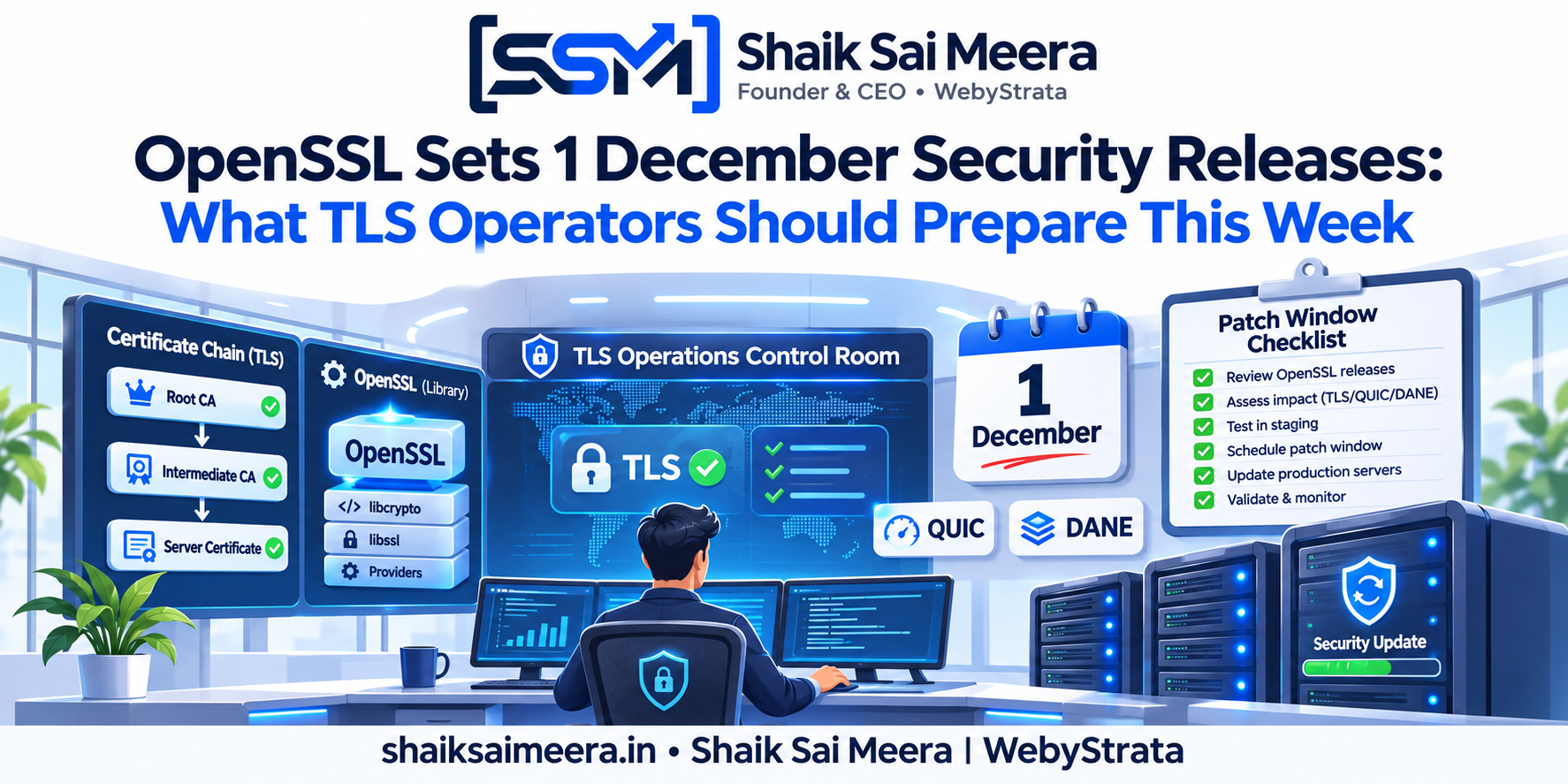
As of 25 November 2026 (IST), OpenSSL operators have a one-week planning window before the project’s next security-fix releases. The OpenSSL project announced releases for 1 December 2026, covering versions 4.1.1, 4.0.4, and 3.5.10, with extended-support builds for 3.0.24, 1.1.1zk, and 1.0.2zt available to premium support customers. The project says the highest severity issue in the release set is Moderate, so this is a scheduled preparation task rather than an emergency patch event.
The OpenSSL project’s release announcement gives the release window as 13:00–17:00 UTC on 1 December. A separate advisory says four low-severity fixes have been merged publicly, covering QUIC resource handling, X.509 CRL processing, and DANE-related TLS behavior. For platform teams, the useful work starts before the tarballs arrive: identify where OpenSSL is directly installed, where it is bundled into another product, and which services will need a restart or image rebuild.
Why a scheduled notice still deserves attention
OpenSSL is rarely visible in an application inventory. It can arrive through a Linux distribution, a container base image, a language runtime, a reverse proxy, a database client, a hardware appliance, or a vendor-managed service. A team may update the operating system and still have a separate container, statically linked binary, or appliance with its own cryptographic library lifecycle.
The notice is also a reminder that “Moderate” is not the same as “irrelevant.” Severity depends on the affected feature, configuration, exposure, and the surrounding application. A QUIC endpoint that accepts incoming streams has a different risk profile from a service that never enables QUIC. A DANE-enabled client has a different profile from a conventional HTTPS client. The first task is classification, not speculation.
Translate the advisory into an asset map
Build a list of OpenSSL consumers from package managers, container manifests, SBOMs, configuration management, and runtime inventories. Include:
- Linux servers, load balancers, reverse proxies, mail systems, VPN gateways, and bastion hosts.
- Container images and build stages that install
libssl,libcrypto, or development headers. - Applications that link dynamically versus statically, because a host package update does not repair a binary carrying its own copy.
- QUIC or HTTP/3 listeners, DANE-aware clients, CMS or PKCS#7 verification services, and any code that enables CRL checking.
- Vendor products where OpenSSL is present but patching is controlled by the supplier.
Record the exact version, build source, deployment location, service owner, restart method, and last verification time. An SBOM entry without a running-process check can be stale; a process check without a build provenance record can be hard to remediate at scale.
What the announced fixes could mean for operators
The advisory describes a possible NULL dereference in non-SMTP DANE clients that can lead to a client crash under an unusual certificate and TLSA-record combination. It also describes two QUIC issues in supported 4.1, 4.0, and 3.5 lines: one can let a malicious peer create an unbounded queue of connection-retirement frames, and another can cause excessive buffering of out-of-order stream fragments. Both are denial-of-service concerns, and both are most relevant to applications that enable the affected QUIC behaviors.
The X.509 issue involves verifying a maliciously crafted CMS or PKCS#7 message with CRL checking enabled. The advisory says CPU consumption can grow with message size and may occupy a core for seconds to minutes. That makes input limits, verification timeouts, worker isolation, and rate controls useful defenses while teams prepare the update.
These are not reasons to disable every cryptographic feature blindly. They are reasons to know which features are enabled and whether an untrusted party can reach them.
A practical preparation plan
- Freeze the inventory. Export OpenSSL versions and owners now, including images waiting in registries and release branches that will be deployed next week.
- Rehearse the update. Apply the distribution or vendor update in staging, restart representative services, and confirm certificates, private-key access, protocol negotiation, health checks, and connection draining.
- Test feature-specific paths. Exercise HTTP/3 or QUIC clients and servers, DANE validation where used, and CMS or PKCS#7 verification with realistic message sizes. Capture latency and error baselines.
- Plan image rebuilds. Rebuild containers from refreshed base images instead of updating only a live host. Rescan the resulting image and check that the deployment actually uses the rebuilt digest.
- Coordinate vendor updates. Ask suppliers how they will deliver the fix, what release replaces the current appliance image, and whether a service restart is required.
- Schedule the production window. The announcement gives a UTC window. Convert it to the team’s local time, allow for package propagation, and keep rollback artifacts ready.
Trade-offs and common mistakes
Waiting for the exact advisory details reduces unnecessary change, but it compresses the time available for testing. Updating every host immediately may create avoidable outages if a vendor package or application has an integration problem. The sensible middle path is to prepare now, patch the highest-exposure consumers first when packages are available, and use a canary for the rest.
Common mistakes include patching only the host while leaving old container layers in production, assuming a process restart happened because a package manager reported success, and treating the version number as proof that the running binary changed. Verify with a process or image-level check, monitor protocol errors, and keep a record of exceptions.
Takeaways
OpenSSL’s 1 December release window gives infrastructure teams a useful head start. Map versions to real assets, identify QUIC, DANE, and CRL-processing exposure, rehearse restarts and image rebuilds, and convert the UTC window into an owned deployment plan. The highest announced severity is Moderate, but the operational lesson is high value: cryptographic libraries are shared infrastructure, and a scheduled security notice is easiest to handle when the dependency map already exists.
This article is a general information summary based on the cited public sources. It is not legal, cybersecurity, or compliance advice.
Related Articles