Tech Insights
Why AI Compute Campuses Are Becoming Grid Resources
OpenAI’s Grid Protectors program proposes flexible demand arrangements so future compute campuses can reduce electricity use when local grids are under strain.
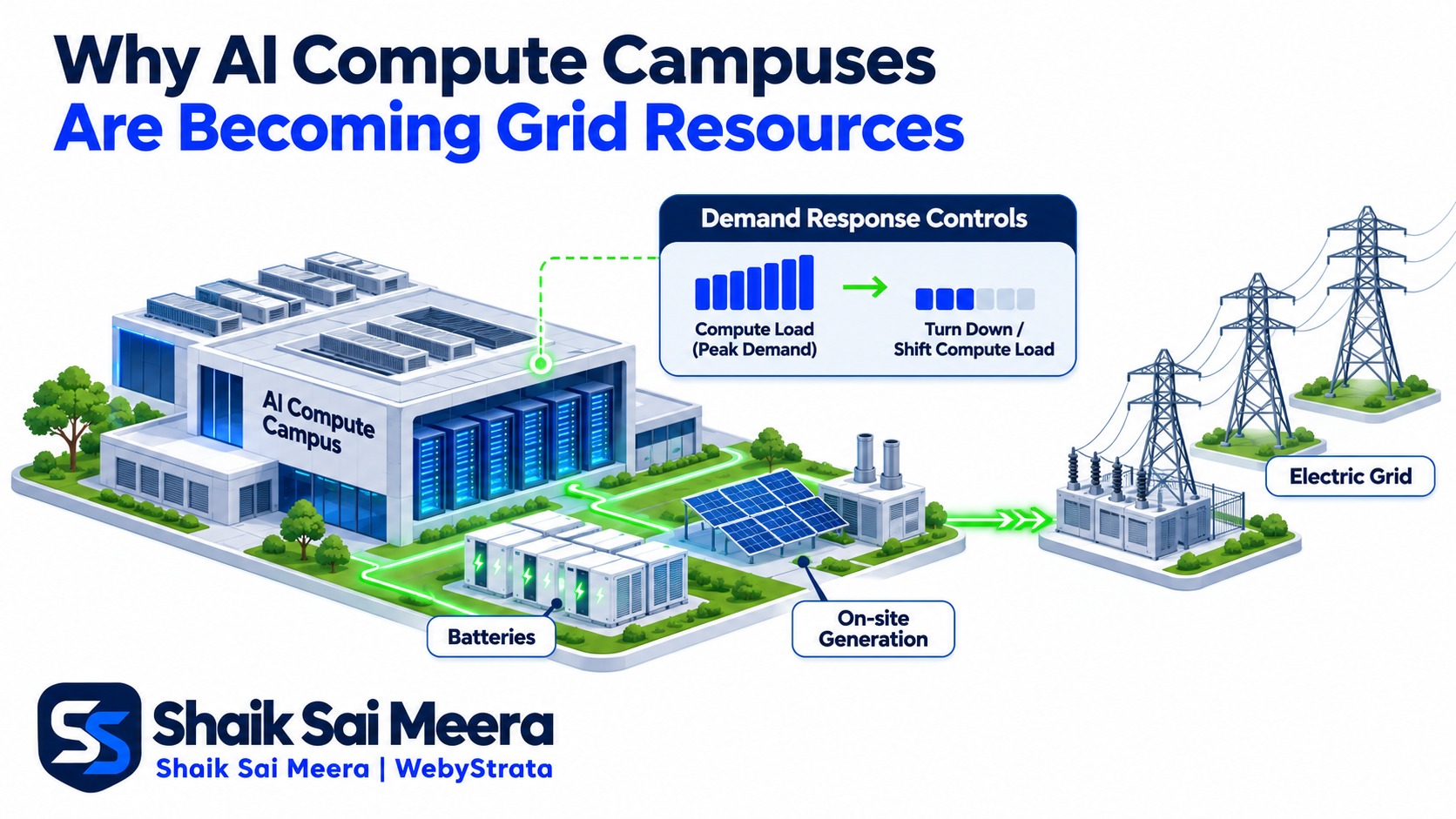
AI infrastructure is usually discussed as a compute story: more chips, more servers and more data-center capacity. OpenAI’s new Grid Protectors program adds another layer to that picture. The company is proposing that future compute campuses should be designed to change their electricity demand when the local grid is under pressure.
In its November 2, 2026 announcement, OpenAI says it is working with utilities, regulators and policymakers on arrangements that could let campuses reduce demand during periods such as extreme heat or cold. Depending on local conditions and equipment, the plan could also use on-site generation, batteries and power controls to smooth changes in demand.
The proposal is not a claim that flexible computing can replace new power plants, transmission or grid upgrades. OpenAI explicitly describes flexibility as something that can work alongside those investments. The interesting shift is that a large AI campus is being framed not only as a customer that consumes electricity, but also as a controllable load that can respond when the system needs help.
Why data-center demand is becoming a grid issue
Electric grids have to serve peak demand even when that peak happens only during a small number of stressful hours. A utility may need enough generation, transmission and substation capacity for a heat wave, a cold snap or another period when many customers use more power at the same time.
Large compute campuses add a new kind of load to that planning problem. Their electricity use can be substantial, concentrated in a specific location and tied to workloads that may have different timing requirements. If a campus always draws its maximum demand exactly when households and businesses are also reaching their peak, the local system may need more infrastructure than it would for a flatter pattern of use.
OpenAI’s program is based on a different operating assumption: some computing work can be shifted, paused or reduced for a period, provided the campus is designed to support that flexibility and the commercial arrangements are clear in advance.
What “flexible demand” means in practice
Flexible demand is not simply switching off a data center without warning. It is a planned agreement that defines how much demand can change, how quickly the change can happen and how long it can last.
For a compute campus, the controls might prioritize workloads that are less time-sensitive, move some jobs to another location or temporarily reduce the power available to selected systems. Batteries or on-site generation could also help the campus avoid drawing as much from the grid during a constrained period.
The exact design will differ by location. A campus connected to a grid with seasonal summer peaks may need a different operating plan from one facing winter heating demand or local transmission constraints. OpenAI says the arrangements will be developed with utilities and will reflect those local needs.
The Georgia pilot
Georgia is the starting point for the program. OpenAI says its planned Effingham County campus is intended to serve as a pilot and that the company has committed to pay the full infrastructure and electric-service costs required to serve the project.
According to OpenAI, the agreement with Georgia Power includes up to 1,000 megawatts of flexible demand response. The company compares that amount with the average electricity demand of roughly 700,000 households, or more households than Washington, D.C., and Boston combined. Those comparisons are OpenAI’s description of the scale; they are not a universal conversion for every grid or customer profile.
The point of the pilot is the operating model. When the grid is under strain, the campus could reduce the amount of power it draws, helping preserve electricity for other customers. When the grid has more room, the campus could use more of its available capacity. That pattern may help spread fixed grid costs across more electricity sales while limiting the need to build new capacity only for short peaks.
Why batteries and on-site generation matter
Demand response is only one part of the design. OpenAI says future campuses may also work with grid operators to supply power from on-site generation or storage, depending on what equipment is available.
Batteries can provide a short-duration buffer between the campus and the grid. They may charge when electricity is more available and discharge during a constrained period, reducing the campus’s grid draw. On-site generation can provide another source of power, although its usefulness depends on the technology, fuel, emissions profile, operating rules and local permitting.
Power controls connect these pieces. The campus needs a way to measure grid conditions, decide which loads can change and execute the response without creating unsafe or uncontrolled transitions. That turns an energy agreement into an infrastructure and software problem as well: the campus must be observable, controllable and able to communicate with the utility’s operating process.
The trade-offs behind the proposal
Flexible demand has limits. Not every AI workload can be paused or moved, and a campus cannot promise a response it cannot deliver during an emergency. A program therefore needs accurate assumptions about workloads, hardware, backup systems and the time required to change demand.
There is also a financial question. A utility may need assurances that a planned campus will be built, connected and available for the commitments it makes. OpenAI says long-term contracts and financial assurances can protect other customers if a project is delayed, reduced or canceled.
Another limitation is that flexibility does not remove the need for new supply and transmission. OpenAI says that directly. A growing AI economy still requires more electricity; the proposed model is about reducing the cost and disruption of meeting peaks, not making new generation unnecessary.
What this means for AI infrastructure planning
The Grid Protectors program points toward a broader change in how compute campuses may be evaluated. A site is no longer only a place with enough land, fiber and power connections. Its value may also depend on how much of its load can be shaped around local grid conditions.
That could influence campus design, workload scheduling, battery sizing, backup strategy and the contracts signed before construction. It may also affect how communities assess large computing projects: the relevant question is not only how much power a campus needs at maximum, but how it will behave when everyone else needs more power too.
For technology teams, the concept is a reminder that AI infrastructure is increasingly linked to physical systems. Compute scheduling, energy storage and grid operations may become part of one planning conversation. The most flexible campus will not necessarily be the one that uses the least electricity at all times; it may be the one that can change its demand predictably when the surrounding system needs it to.
The bigger takeaway
OpenAI’s announcement is an early program, not a finished industry standard. Its Georgia pilot will show how the proposed arrangements work in a real location, and future commitments may differ by utility and region.
Still, the direction is clear. As AI increases demand for large-scale computing, the design of a data center may include a new responsibility: helping the grid absorb that demand without asking households and small businesses to carry the cost of every peak. In that model, the compute campus is not just a load on the grid. It is part of the grid’s operating strategy.
This article is a general information summary based on the cited public sources. It is not legal, cybersecurity, or compliance advice.
Related Articles